Belligerent Q&A, Vol. III: Travis A. Everett of Tunnel Traffic


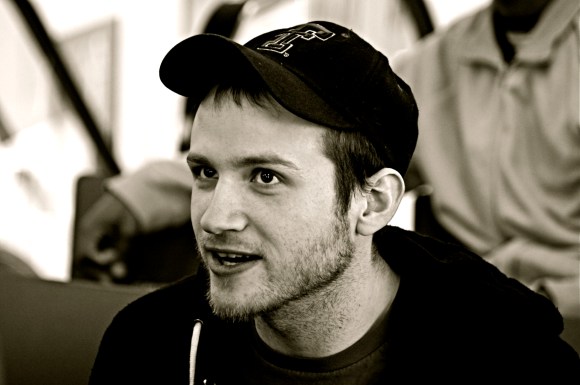
Travis A. Everett, who is from Texas, wears a hat with not one but two Ts on it in this photo. He is the founder of Tunnel Traffic, an occasional reading series. Texans seem to like a certain kind of alliteration. Photo by John-Henry Doucette.

Tunnel Traffic is an open-mike reading series that generally is held at Borjo Coffeehouse near Old Dominion University in Norfolk, Va.

The series was developed by Travis A. Everett in coordination with the MFA Creative Writing Program at Old Dominion University. One of its sponsors is Barely South Review, the program’s online literary magazine. By way of full disclosure, I’m a student in the MFA program and was one of the fiction readers for the review this past year.

I recently traded emails with Everett, since the next reading is coming up on Wednesday, April 13. The topical reading series is meant inspire new work and provide reading experience for students, according to the webpage. Writers write to prompts announced before each reading. The vibe is meant to be low-pressure and casual.

In addition to his studies at ODU, Everett is a poet and the founding editor of escarp, a text message-based review of “super brief literature.”

This Belligerent Q&A is about Tunnel Traffic. In case you missed the photo cutline above, let me mention that Everett is from Texas. I wonder if that will come up.

Q: Just who do you think you are? Please use three examples in your response.

  1. An accident waiting to happen
  2. A typography/design geek
  3. A weekend programmer

Q: It seems to be an interesting choice to name something Tunnel Traffic and expect people from Hampton Roads to want to experience it. Please describe your marketing plan in a limerick, haiku, or rhyming couplets.

I come from West Texas
where sky is the coolest thing
you can drive under

Q: The bling, the flashy cars, the reality shows – hasn’t the public had enough of the ostentatious lifestyles of the creative writing community and its twisted, insatiable passion for the subversive forms of fiction, poetry and narrative nonfiction?

Well, I think that’s actually one of the problems contemporary literature faces. So the equivalent of a Benz and a bottle of Cristal is a stuffy reading voice or a highly referential style that both resist non-writers — and the reality-show analog is writing about a writerly life like it’ll matter to anyone who isn’t a writer. There’s room for that, of course, but I also think it’s a really self-fulfilling prophecy to bemoan the lack of readership for very writerly books of poetry and prose. So in that sense, yeah — I think the public has had its fill of a specific kind of writerly lifestyle.

Q: Your readings are “topical” – please explain. Does that mean topical like a Jay Leno monologue, or topical in a way that prolongs one’s will to live?

Or topical like anti-itch cream? So you can listen to one late night monologue and hear a joke about, let’s say, a runaway Toyota, and you might laugh. But a single joke doesn’t show how far the content can stretch. Let’s say it’s topical like a roast, or a slam-dunk contest: shedding the usual rules of the dance give it a relaxed, fun, informal atmosphere with an undercurrent of both inter- and intra-personal competition.

In some sense it doesn’t matter, on The Tonight Show, if Jay has the best Toyota joke or not (as long as his joke is at least funny) because he’s not in a topical context. But if you take a number of late-night hosts and other comedians and let them know you’re having a runaway-Toyota-joke-night, they’re each going to be looking for an angle no one else will take and as a result they’ll cover a lot more territory, territory they probably wouldn’t have opened up as individuals outside of that context.

Q. We’ve covered so much ground here. What else would you like to say?

If you commit to coming, a topical prompt will help you write something you probably wouldn’t have written otherwise. Seeing how other writers approach the same task can help expand your sense of what words can do. It’s a low-pressure way to get reading experience.

The next Tunnel Traffic reading is scheduled from 8 to 9:30 p.m., Wednesday, April 13, at Borjo at W. 45th St. and Monarch Way. The topics are Easter eggs and/or gunpowder. Members of the public are welcome to come out either to listen or to read.

Tagged , , , , , , , , , , , , , , , , ,

Poetry that recognizes the struggle against sexual assault


Breaking the Silence, Speaking for Peace, a poetry reading to raise awareness of the struggle against sexual assault, will be held Monday, April 11, at Old Dominion University in Norfolk, Va.

The reading features several ODU poets, including Luisa Igloria and Tim Seibles. They will read poems that speak to survivorship, peacemaking, healing from trauma, or the struggle against sexual assault.

The event is sponsored by the MFA Creative Writing Program at ODU and the ODU Women’s Center. The reading is from noon-1:30 p.m, Monday, April 11, in the James Lynnhaven Room, Webb Center, Norfolk. Admission is free.

By way of full disclosure, I’m an MFA student at ODU.

Igloria, director of the MFA program, said via email that she had been looking for an event to commemorate National Poetry Month. Wendi White, graduate assistant with the Women’s Center, approached Igloria about holding a joint project.

White works with the center’s Sexual Assault Free Environment, or SAFE, an educational program on sexual violence and relationship issues. She’s in her first year with the MFA poetry program.

White, via email, said the poetry event will help raise awareness about sexual violence and help people prevent it – with attention, of course, also paid to the issue of sexual assault on college campuses. Regarding the connection between poet and audience, White added:

This is a very powerful transaction that can transform how the reader sees the world, and therefore, the world itself. … (P)oetry can create empathy for survivors and lift up the possibility of peace in a way that moves people to action.

Serving the Old Dominion University community since 1976, the Women’s Center is the oldest center of its kind on a Virginia college campus. Our programs and services address the special challenges and opportunities women students encounter as they pursue their academic goals. Also, recognizing the critical role that both women and men play in creating a world that is free of gender bias, our goals include promoting healthy relationships and a safe and equitable environment that is free of barriers to all persons.

Said Igloria:

When folks hear of either one – poetry, or women’s/gender issues – I think that it may still very well be the general perception that these are ‘fringe’ types of topics but that couldn’t be farther from the truth. …

This reading event is open to the university, as well as to the general public. Folks can participate by being part of the audience and coming to hear great poetry read, or by reading one or two short poems. It can be either their own original works or by another poet, as long as the poems selected address the general topics of violence against women or our struggles in general to create peace in our world.

It may seem like this is a broad umbrella, but I think this makes it possible for different voices to participate in the activity.

Featured readers include Til Cox, Tyrice Dean, Travis Everett, Jennifer Graham, Igloria, Renee Olander, Noah Renn, Seibles, Marion Charlene Thomas, Cesca Janece Waterfield, and White.

For more information or to participate, reach White via wewhite@odu.edu or (757) 683-4160. Members of the public who want to read must contact White before Wednesday, April 6, to sign up.

Igloria wrote that she’s still determining what she’ll read.

Thinking about and preparing for it makes me think of how very central and very important language is in shaping the realities of our lives, globally as well as where we are; and I think poetry has this capacity for making us aware of the effects of language, and for speaking very intimately to us as well as addressing concerns that are universal.

When I listen to (or read) a poem, I feel very much in the presence of a very human experience; poetry makes me feel like a witness to human events that are important and real, no matter how ‘small’ they may be. Perhaps that’s why I recently ranted (a bit) about the way National Poetry Month is being ‘celebrated’ in some popular venues.

A link to that post at Igloria’s blog can be found here.

Tagged , , , , , , , , , , , , , , , , ,

Mike D’Orso book signing Wednesday in Norfolk


Norfolk, Va., writer Mike D’Orso will discuss and sign copies of his new book this week at Borjo Coffeehouse near Old Dominion University.

D’Orso, an award-winning author and formerly a journalist with The Virginian-Pilot, collaborated with the actor and environmental activist Ted Danson to pen Oceana: Our Planet’s Endangered Oceans and What We Can Do to Save Them. It was published by Rodale Books earlier this month.

The event is being held by Prince Books, a terrific bookstore in downtown Norfolk that for years has supported local writers – even when we haven’t had anything to sell.

Prince Books is one of the best things about downtown Norfolk. I’ll fight anyone who says otherwise.

The discussion and signing is at 7 p.m., Wednesday, March 30, at Borjo, 4416 Monarch Way, Norfolk. That’s at the corner of W. 45th Street and Monarch Way. Pretty much all of the parking around there is metered before 8 p.m., so bring a couple of quarters.

As regular readers of this blog may recall – love you, Mom – Mike spoke with me for a couple of posts earlier this month, including guest starring in the inaugural edition of the inexplicably and, let’s face it, only relatively popular Belligerent Q&A feature.

Also a more serious discussion on one of his great journalism stories can be found here.

Hope to see you Wednesday at Borjo.

They have coffee and grownup bevs for sale. Just throwing that in there.

Tagged , , , , , , , , , ,

Why We Have the Internet, Vol. III: <$20M Need Not Apply Edition


Second from the right above. Red tie. Yeah, him.

Gene Simmons wants to insure you as only the god of thunder and rock’n’roll can do.

The KISS bassist and businessman has joined forces with a financial services group. This is a real thing for about a year now. The Internet says, so I’m 51 percent sure.

First, some palate-cleansing KISS haiku.

No more tomorrow.

Time is today. Girl, I can

make you feel okay.

— ‘Love Gun‘ by KISS (1977)

Did I make you feel okay? Did I take you somewhere, such as the wide expanse of real estate roughly in the middle of good and bad? You’re welcome, baby.

Okay, Paul Stanley actually wrote that one. And Paul Stanley doesn’t have to shoot for the stars when there’s a Hardees around the corner.

But Gene Simmons is the awesome one. He breathes fire. Spits blood. Wears platform shoes so motivated it’s like he’s walking around on two little stages.

He isn’t kidding around:

Turn it up. Hungry

for the medicine. Two-fisted

to the very end.

— ‘I Love It Loud’ by KISS (1982)

Gene Simmons is so mighty he makes you break the rules of poetry. When you try to make a haiku of his lyrics, the middle line doesn’t scan.

Anyways. Third from the left below.

In the gag version, the signatures aren’t under the right guys.

Look, Gene Simmons is classy. Ask Terry Gross. Just don’t try to click on the interview at NPR.org:

Audio for this segment is unavailable for legal reasons.

What is available?

Life insurance products for the wicked well-off via Cool Springs Life co-founder Gene Simmons.

I feel good about this.

Because Gene Simmons is the mastermind of merch. Books. TV. KISS fragrances. KISS collectible wine. KISS high performance ear buds. KISS logo trailer hitch covers. The Lord of Rock framed 24 karat gold-plated LP. KISS baby shoes (the extended tongue was a nice touch).

All fine and good.

But it takes more than KISS Destroyer diaper bag sales to keep Gene Simmons in cold cream.

Based in Franklin, Tenn., the (Cool Springs Life) is engaged in providing life insurance to wealthy Americans and foreign nationals through a proprietary premium finance platform known as ‘The Cool Springs Life Equity Strategy.’

Right on. Maybe I can do my part as a consumer. I could use some high cash value life insurance, for example. But I’d also like help arranging a loan to pay the premiums. Hmm.

Cool Springs Life partners with the most reputable and respected life insurance carriers to offer you access to products that can provide extraordinary cash value accumulation. These products have historically exceeded the projected borrowing costs for this product.

Just don’t waste anybody’s time, a near-haiku warns:

Cool Springs is designed

for individuals with …

over $20 million …

— ‘Request More Information’ by Cool Springs Life LLC (2011)

Nuts. Last line is over by a syllable. Meanwhile, I’m under by roughly $20 million.

At least, thanks to Gene Simmons and YouTube, I can rock out for free.

Let’s do this thing:

NPR interview hat tippage: Erim Foster at Erim.net

Tagged , , , , , , , , , , , , ,

Why we have the Internet, Vol. II: Disemboweled Tauntaun Edition


With George Lucas returning his Star Wars films, in 3-D, to theaters beginning next year, I’ve considered whether I should begin saving up for a ticket, rather than, let’s say, Old Dominion University tuition or food for my family.

Since I learned the first will be The Phantom Menace, I think I’m still state school-bound – in part, because I’ve found grad school as warming as the innards of an ice planet transport animal. Please click that link, and consider that this packaging come-on sounds an awful lot like sad, on-the-nose Star Wars dialogue:

Now with open belly rescue feature!

Because, you see, they redesigned it.

I suspect the problem with the The Phantom Menace is that – in addition to already being repackaged and redeployed to theaters a few short years after introducing the subatomic suck bomb of Jar Jar – it lacks the vision of improving certain tie-in toys by disemboweling them.

Still, Star Wars remains a cultural touchstone, though some of the most interesting ideas from the SW universe are not Lucas-originated. Also, they’re online. Consider what a gift it is …

To order this and deliver it unto me, S&H be damned.

To look at this whilst considering the progress of man as expressed by our arts.

To criticize this. And this. And this. Also, this. Oh, this, too.

And to pity the owner of this.

Did someone order this?

Mr. Internet keeps Star Wars interesting despite itself.

Hat tips: ThinkGeek, Awesome Internet Site, That’s Nerdalicious, Technabob, Geek.com, and the Star Wars Collector Archive

Tagged , , , , , , , , , ,

Before the race, a roll call of remembrance and hope


Before the races began at the Oceanfront this weekend, members of the Hampton Roads DetermiNation team gathered Friday evening at the American Cancer Society office on Expressway Drive in Virginia Beach, Va.

Team runners and loved ones worked around a conference table. They made ready their signs and jerseys. They wrote name after name.

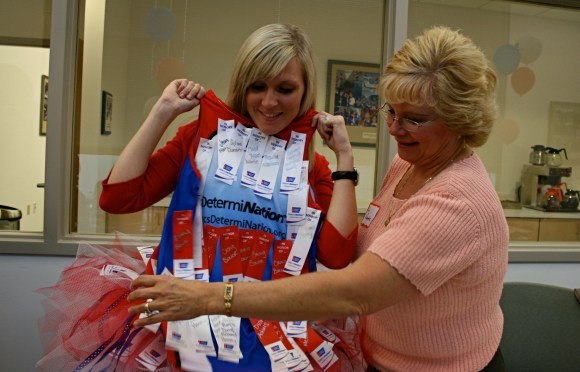
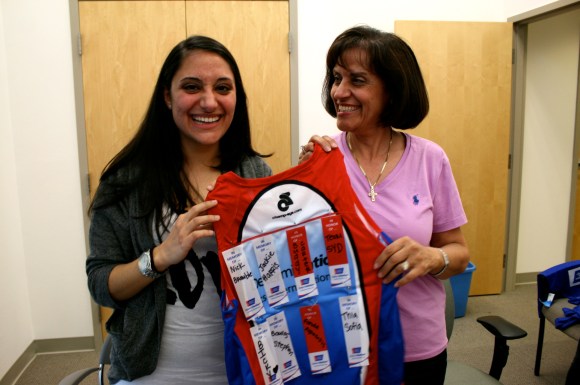
Lisa Creech, a 26-year-old Beach woman, decorated her jersey – and a tutu – with red and white ribbons ribbons affixed with safety pins. Each ribbon bore a name. Red ribbons were for survivors, white in memory of those cancer has claimed. Creech said:

My dad passed when I was 16.

Her father had non-Hodgkin’s lymphoma. An uncle, a thyroid cancer survivor, has brain cancer and recently learned that he may have bladder cancer. She’s running for both of them. She’ll carry the names of many other people on ribbons:

I had one change from red to white right in the middle of fundraising. It just makes me want to kick butt that much harder.


Lisa Creech and her mother, Pam DeSantis, worked to decorate Creech's jersey and a tutu.

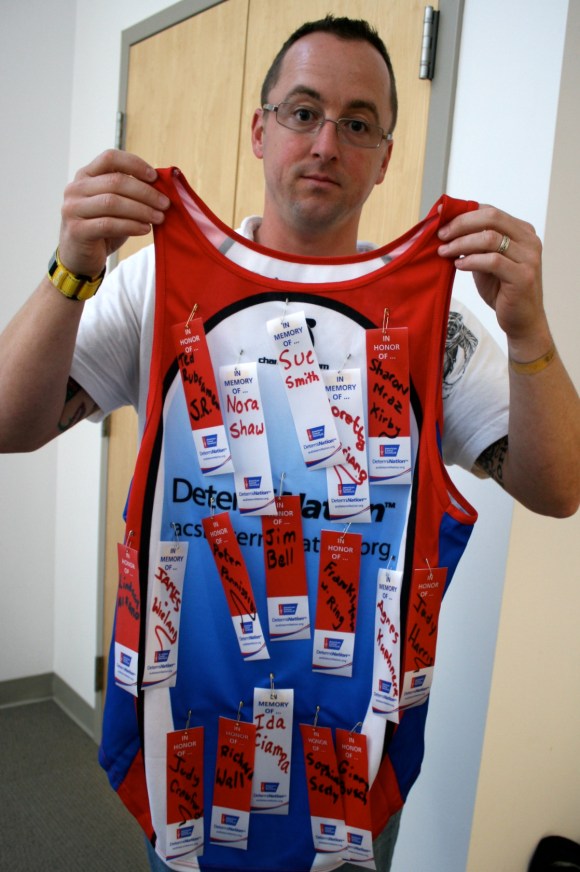
Mark Moritz, a 36-year-old Beach man, is running to raise money and awareness. He’s running in honor of his father-in-law, a survivor for six years now. Among others, he noted, looking at the many ribbons he had marked with names:

Not even everybody, I’m sure. I’m sure I’m missing somebody. …

I hope (the ACS) just keeps raising money. We know there’s a problem. The more people see it, the better the chances.


Mark Moritz holds up his jersey, decorated with names of cancer survivors and others whose lives have been lost to the disease.

Mimi Kopassis worked with her daughter, 23-year-old Eleni Kopassis, who is running to help the fight against cancer, and for family and friends. Mom is proud:

I think it’s awesome. A wonderful cause. We need to have more people participate.

Eleni Kopassis said the people who are battling various forms of the disease are her inspiration:

If people can survive cancer, you can pretty much do anything.


Eleni and Mimi Kopassis hold the jersey Eleni will wear when she runs this weekend.

The American Cancer Society DetermiNation program involves a number of endurance events across the country. You can learn more about the society and the program at this link. You can learn more about the Shamrock weekend effort by the local team here. And donate, too.

After the jerseys and posters and a tutu were decorated on Friday, there was a dinner. Lots of pasta and bread. Pure carb loading.

My wife, Cortney, spoke about her recovery from thyroid cancer during the dinner. For those who know us, you know what our past few months have been like. You also know that we’ve been lucky and blessed. And you know that saying I’m proud of her is only the tip of something I can’t seem to put into words.

Here’s one thing she had to say last night:

When it becomes your reality, it’s terrifying.

But of course there’s hope. That’s why a lot of folks among the runners at the Shamrock this weekend are carrying names with them. White ribbons to remember, red to show this thing can be beat.

A few shorts months after her operation and her treatment, my wife is running tomorrow. She’s running for a lot of folks we know and love. She’s also wearing a red ribbon for one of the many heroes running this weekend – herself.


Cortney Doucette, my wife, holds up one of the ribbons she will wear during her run tomorrow at the Beach. She's one of the local DetermiNation team members raising money for the American Cancer Society.


Tagged , , , , , , , , , , , , ,

The Newseum


Newseum entrance, Washington D.C., March 15, 2011. Vox Optima photo.

I visited the Newseum yesterday with several folks from Vox Optima, the first time I’ve seen it the museum in it’s relatively new location on the 500 block of Pennsylvania Ave. N.W.

Among the great exhibits was Covering Katrina, on display until September. It’s a very moving series of displays that included front pages from throughout the initial period of the storm, examinations of the reporters covering the tragedy, and, for those overcome by some very powerful images, boxes of tissues at the end of benches.

Said Jim Washington, a former reporter for The Virginian-Pilot and my colleague at Vox:

It was pretty amazing. I was surprised how emotional the Katrina exhibit was, especially since its a news story we’ve been exposed to for so long.

A great museum. Worth checking out if you’re in D.C.

A few images from the trip follow.

A view from one of the upper levels. To the left is a recreation of the office of the late NBC journalist Tim Russert. Vox Optima photo.

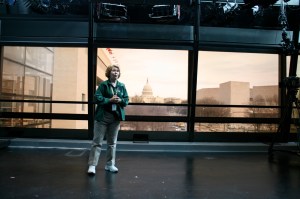
Jane Howard of the Newseum discusses the ABC This Week studio in the museum in Washington D.C. on Tuesday.

Detail of a section of the Berlin Wall, on display at the Newseum, Washington D.C., on March 15, 2011. Vox Optima photo.


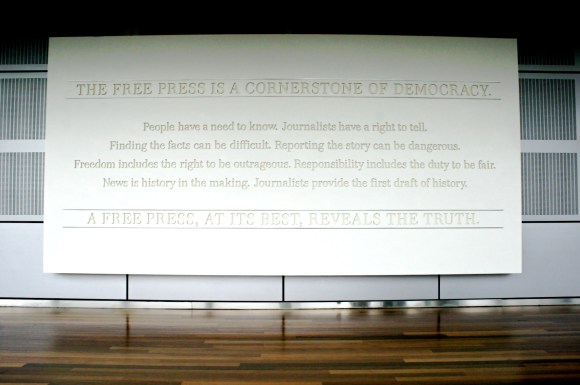
Well said ... at the Newseum, Washington D.C., on March 15, 2011. Vox Optima photo.

Tagged , , , , , , , , , , , ,

Writing Craft, Vol. II: Kristin Naca (Part 2)


This is the last part of a discussion with Kristin Naca, the Spring 2011 Visiting Poet in Residence for Old Dominion University’s MFA Creative Writing Program, that took place this past June. There are two upcoming events in Norfolk, Va., featuring Naca that are open to the public. Admission is free. You should check them out:

  • From noon to 1 p.m., Wednesday, March 16, there is a craft talk called “The Secret Tradition: How Translation Revolutionized 20th Century Poetry.” The talk will be held in the Burgess Room, 9024, in the Batten Arts and Letter Building, at the corner of West 45th St. and Hampton Boulevard, Norfolk, or across Hampton Boulevard from the Ted Constant Convocation Center.
  • And at 5:30 p.m., Thursday, March 17, Naca will hold a poetry reading at the University Village Bookstore. Copies of her book will be available for purchase and signing, and refreshments will be provided. The bookstore is located at 4417 Monarch Way, Norfolk, at the corner of Monarch Way and West 45th St.

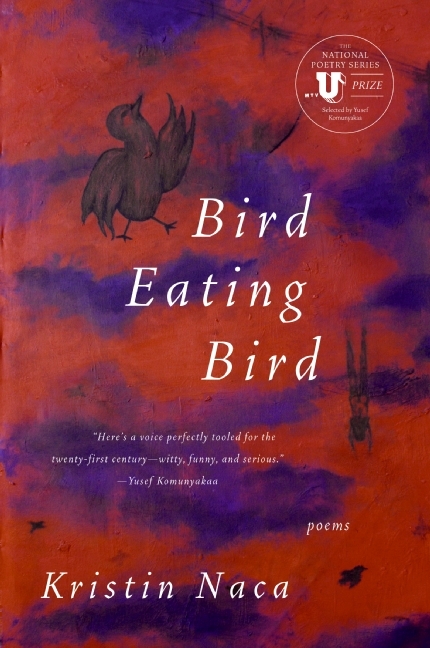
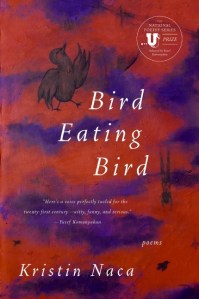
Naca is the author of Bird Eating Bird. What follows has been edited for clarity and length.

Q: When you read the third draft or the fiftieth draft, do you know that you have it?

(Laughs.) Sometimes. Well, when it’s encroaching on really finished, I’ve probably been working on it for a while and typically I’ll be able to figure that out that it is done, that the plaster is setting. I think the trick for me is I’m pretty open. I didn’t care how long it was going to take me to finish a poem. There were a couple of poems that were published in a really different version that were reworked for the book.  Sometimes you really just need the right word from somebody and it will motivate you to work really hard at your work. … Like the last poem (in Bird Eating Bird), “Catching Cardinals,” Prairie Schooner published an earlier version of that poem. It went from a poem that looked like a baptism poem about the kid. It told the story that it wanted to tell in that form and then my advisor said I don’t want this to look like a composed poem, so she asked me to break it up into quatrains and then I did that. And then my girlfriend at the time saw it published in quatrains and she asked why it was in quatrains. When she said that, it helped me rekindle a memory of being in a poet, David Wagoner’s, class. David is a really well known poet who is a phenomenal teacher. He has a lot of poems memorized and he could just do off the top of his head. He was a poet who tried to help all of us at University of Washington train our ear. It was very much his idea that these numbered kinds of stanzas are more like musical measures. So a couplet is really supposed to work musically as a couplet in and of itself. So he would recite Wallace Stevens, and then it was like oh I can hear the couplets. I don’t need to hear them for the story to be told, I need to hear them because rhythmically it makes a song. … Then working with my friend who is a formalist … I’ve always tried to write formal poems to train as I write my work but finally I felt like this form, the quatrain form, would force me to cut out all the unnecessary language, for one, and it would shape the story in a way that I wouldn’t be in control of, but if I worked the form it would heighten the effect of the poem.

Q: I hadn’t even thought of that but given the topic …

Yeah. I think I only learned that from taking a form workshop to varying degrees of success. Every time I took one I got better. ‘I’d better do this because this poem is going to be so cool.’

Q: The class we’re taking is an Asian American lit class and one of the themes that we’re talking about is assimilation and I wondered if you could talk about that poem (“Catching Cardinals”) and assimilation.

That’s a great question. This is a form of community established in the United States that inaccurately, historically combines conservative politics with conservative forms. I don’t know why that is but if you know the history of poetry, you history of form, cultures around the world are writing in various set forms. And I think the book of poetry that helped me get over the hump to learn how to write in quatrains was Songs of Gold Mountain, which was a book from Chinese migrant communities. The translations are pretty remarkable. They’re able to translate the meter of a couplet in the original poem. The translations are beautiful and demonstrate how different a couplet is in English, a British sort of influence, a Western influence, to what the couplet does coming from the East. There is a great deal more melancholy in the couplet from the East. It’s sort of relinquishes control. It’s haunting. I was teaching and Asian American poetic class that fall and finally I had the music of the couplet that I wanted to write in my ear. At first I’m doing something like classic borrowing but from an Asian form, not necessarily a British form. … I’m going from a Western concept but then from an Eastern concept I’m learning that sense of melancholy and this is the kind of couplet. It was an amazing opportunity for me. … Then there’s like resistance. People who don’t know that history will easily read it as a Western treatment.

Q: Is that frustrating?

It’s actually a little demoralizing. I think people sometimes like the sound of the poem but don’t understand. I don’t know that any one poet or any one audience could ever understand all of the treatments that I was using. Or the historical conversations that are happening … I don’t know (how) to feel about it but I definitely know that I do feel. I guess it’s just lucky if people get anything. … To hear certain lines in your voice and your construction and how you are translating – how you know a certain line or a certain thought – that has a lot of meaning for me. Maybe I talk to people who see the poems or good or relevant, but so much of the subject matter in the book it’s completely theological to them. That’s a little bit of an intensifying of my experience. … It’s kind of a sad reminder. You can’t teach people everything and you can’t say everything either.

Q: When I read the reference to your uncle in Manila I just think it takes the poem to a whole other place. The way I process things is it makes me think of things from my own life. But I don’t think I would have noticed certain lines that I noticed had I not taken this class.

That’s a good argument for those kinds of cultural studies and ethnic studies classes. The reason you do that is you don’t know anything in the first place.

Q: What do you want people to take away from your work?

Try to understand to let the poem effect you and to open your heart to the poem. If you can do that it really cuts down the barriers. If I could request anything, not even tell people to do it is, especially if they don’t understand it, is to read it with their heart first.

For more information on Naca, please visit her site here.

Tagged , , , , , , , , , ,

Writing Craft, Vol. II: Kristin Naca (Part 1)


The following discussion with Kristin Naca, the Spring 2011 Visiting Poet in Residence for Old Dominion University’s MFA Creative Writing Program, took place this past June. It was for a class, and she graciously has agreed to let me publish sections of it. As I posted recently, there are two upcoming events featuring Naca that are open to the public. Admission is free. You should check them out:

  • From noon to 1 p.m., Wednesday, March 16, there is a craft talk called “The Secret Tradition: How Translation Revolutionized 20th Century Poetry.” The talk will be held in the Burgess Room, 9024, in the Batten Arts and Letter Building, at the corner of West 45th St. and Hampton Boulevard, Norfolk, or across Hampton Boulevard from the Ted Constant Convocation Center.
  • And at 5:30 p.m., Thursday, March 17, Naca will hold a poetry reading at the University Village Bookstore. Copies of her book will be available for purchase and signing, and refreshments will be provided. The bookstore is located at 4417 Monarch Way, at the corner of Monarch Way and West 45th St.

Naca is the author of Bird Eating Bird. The poems include three languages, Spanish, English and Tagalog. I started out our talk asking about some poems that appear in Spanish and then in English, though the translations are not mirror images. I have edited the following for clarity and length.

Q: When did you start writing in Spanish? Was it for the MFA project, your first book?

I think I was revisiting the interest I had even as an undergraduate. My Spanish … really wasn’t in my bones in any way at that age. I’d been in Spanish class a lot but hadn’t really explored whether I had any personal connection to it. At that time I did, but I feel like I didn’t have the resources at that young age to align my memory and to get a thoroughly immersed in Spanish like I did in my MFA project. It shouldn’t have the same relevance to me when I was that young. Once I was out on my own longer … As an artist, you’re really crafting yourself and your personality. My personality and who I was is really interlinked in what I was studying.

Q: (One poem in Spanish is called “Seguir”; the English version is “Seguir: To Follow, Keep On, Continue.”) The title of the translation, it’s almost like there aren’t the words in English to explain this one Spanish word.

I think the title is very much like it’s own dictionary entry, you know? I’d been working on a few different words with that approach, in particular words where the concept was complex, and the construction of what they mean. I wasn’t sure I understood the translation. … The word is like a concept of time and how we experience time. … Imagine like how the word works in time, that’s what I think I was trying to find a metaphor for. It’s like a really weird word. Sometimes you can use it to cast out into the future and sometimes it talks about what has happened in the past and sometimes it’s related to the future. … It’s a verb that has a past and a future to it. I was trying to work with these phrases that were like reflections, and I think even “Todavia No” is even like one of those choices. … The concepts of something not quite being there or something still being there.

Q: I wondered how you are assembling the images and the words that get you where you want to go. Does it start with just one idea?

I don’t know if this unusual. I ended up just observing what was in my immediate environment, and tried to write down anything I could observe in detail and also in another language, when I was in Nebraska. Interestingly enough, this is in the details of nouns, but it’s what I can see around me.

Q: Did you write it first in Spanish?

First in Spanish. I was trying to demonstrate where the fragments of my Spanish were. Like, where the ragged ends of my lexicon were. If I didn’t know a word … Sometimes the word isn’t at my finger tips. And then there’s alliteration. I’m definitely someone who will alliterate until I hear the word I’m looking for. I’ll do that in Spanish and I’ll do it in English, too. …

Q: “Todivia No” was one of the poems where I read it and I wished that I had written it. One of the things I struggle with is structure and it just seems, it’s so hard to explain. I just can’t picture it being written another way.

I have a friend who writes fiction and she’s kind of a young literary fiction writer, and she says don’t you feel like you can just futz around with in for ever, when I was in the last two months of editing it, and I was just like no, poems are … at a certain point you cannot rearrange it. That’s when you know. If the poem has a life of its own then someone else can read it see the intangible elements. I think maybe because I’m a relatively young writer too, when you’re compositing a certain way. I guess the best way to describe it is reaching negative capability. You really do empty yourself out and try to comply to the will of the poem. If you hear that there is a poem in there or if you hear that there is a poetic dimension that are just like around the corner, the you let go of what you want the poem to be, what you were trying to force the poem to do, and eventually you let the poem come tell you how it’s supposed to go. It’s not the easiest process. It’s just like, strip down your ego, you know? And say my original intention is not what’s important. What’s important is the intention of the poem that’s there. Or at least the poem that’s better. (Laughs.) I don’t know if you feel that way writing stories.

Q: I do. Actually, I had a workshop last year where I kind of got out of my own way.

That’s exciting. It’s exciting and it’s hard to do. And once you do it once it’s like now I have to do that 100 more times or as many times as I need to. That can be a scary process.

Q: You had very little Spanish when you were a kid?

Yeah. Practically none. It was only like when certain relatives would come in from New York City. When my grandmother would come in from, I think she was living in Maryland. My father would speak Spanish only to them, and not to us.

Q: I just want to tell you, in “Uses for Spanish in Pittsburgh,” a line I love: “Still I remember he spoke a hushed Spanish to customers who struggled in English, the ones he pitied for having no language to live on.” One of my favorite lines.

Thanks. I really appreciate that. … I think my parents were very much like the economics of learning certain languages just don’t make sense. And Spanish doesn’t make economic sense. Though my father said that he heard a quarter of the globe would speak Spanish by 2000. But he wanted us to learn Chinese. He was much more in favor of us learning Chinese than Spanish. He thought that was more economically viable.

Q: Similar to my mother’s experience with Italian. The kids didn’t speak Italian. The words my mother and uncles carried forward are the words I heard when I got in trouble.

(Laughs.) The cursing and sometimes swearing, right? That’s gotten me in trouble once or twice with Tagalog.

Q: Did you have the same experience with Tagalog?

It’s exactly the same kind of thing as you said. We learned like body parts. My mother’s family is like I guess third-world poverty working class, and whatever I learned in terms of body parts were much more crude than I think people in the city were learning and, while I was aware that the Catholic Church is a power in the Philippines and there are elements of shame, like shame for the culture or social rules, I didn’t really understand how that shaped the language I learned. So I met a another Filipino writer and she was a year behind me and we talked about the shame involved in openly talking about sexuality. At the time any Filipino I knew was just saying the body parts and such. When I repeated it back (to the other student) when she heard me say – and apparently it wasn’t just like the names of body parts but I was also saying phrasing I didn’t know, and it had been vulgar. When the whole things went down, she blushed. I didn’t know Filipino people could blush. She just turned beet red. She was like afraid of me for the things I had learned to say. It was like in a really crude form. It was a little bit of class difference in what my family was teaching me, and her background. … I think the story of my life is I’ll come into contact with a language other than English and I may not know the dynamics of the way I’m learning it or a full sense of what I’ve learned or what I’ve actually heard. And then I have an opportunity to learn. … Luckily I realized I enjoyed learning about language. I had no idea I would enjoy learning about languages until I got further along in my studies.

Q: Did you feel personally that language was missing, that you wished you had more of it?

I really wanted to learn it. I was really good at languages until I was 13. When I started studying Spanish in high school …  generally, I was a really bad student, but that didn’t relax my curiosity about it. And when someone tells you not to it’s just burned into your memory in a way that it’s an indelible thing that you must have. That couldn’t have been more clear to me in that it developed into a profound interest in studying Mexican American writers. And then having them become my circle of thought and colleagues, and then I could not not pursue it. Everything is pointing in the direction  of this is what I should do. It was the first time I had a scholarly pursuit and my scholarly pursuit was hand in hand with like a natural curiosity.

Q: The poems are so personal and powerful, does it come just a core part of your personality at that point? Was it just real effort or was it both?

I think you’re asking the age old questions. I think what I learned in my MFA, though I couldn’t really express it, was I had more intellectual faculty than I thought I did. … I think when you’re an MFA student your main goal is to become a better writer, not to write a book. You’re going to write an entire manuscript, for instance, but it’s sort of like you don’t have to worry about it. You have to do it in order to graduate. The real opportunity should be to learn as much as you can, change and grow as much as you can. I learned that you just have to really study you craft and that so much of the world will sort of unlock for you if you work on it. It was sort of my passport into a community.

I’ll post more of this discussion shortly. For more information on Naca, visit her site here.

Tagged , , , , , , , , , , , , , ,

Belligerent Q&A, Vol. II: Kristin Naca


Kristin Naca is the Spring 2011 Visiting Poet in Residence for Old Dominion University’s MFA Creative Writing Program in Norfolk, Va. In addition to working with some really lucky MFA students – including me – there are two events that are open to the public (and free). She’s amazing, so I hope you can make one or both:

  • From noon to 1 p.m., Wednesday, March 16, there is a craft talk called “The Secret Tradition: How Translation Revolutionized 20th Century Poetry.” The talk will be held in the Burgess Room, 9024, in the Batten Arts and Letter Building, at the corner of West 45th St. and Hampton Boulevard, Norfolk, or across Hampton Boulevard from the Ted Constant Convocation Center.
  • And at 5:30 p.m., Thursday, March 17, Naca will hold a poetry reading at the University Village Bookstore. Copies of her book will be available for purchase and signing, and refreshments will be provided. The bookstore is located at 4417 Monarch Way, at the corner of Monarch Way and West 45th St.

Naca is the author of Bird Eating Bird, a great collection of poetry chosen for the National Poetry Series mtvU prize by Yusef Komunyakaa, the 1994 Pulitzer Prize winner in poetry. Naca teaches at Macalester College in St. Paul, Minn. She was born in Washington D.C. and raised in northern Virginia.

I spoke with Naca in June for a class at Old Dominion University, and will post a couple of excerpts from that talk in the next few days. Today’s post contains her responses to a recent email exchange, and if this “Belligerent Q&A” seems light on my customary foolishness, it may be because the subject will be grading me.

Q: Just who do you think you are? Please use three examples in your response.

  1. A wandering poet
  2. A distracted yogi
  3. A wishful filmmaker

Q: You interviewed Yusef Komunyakaa for a certain cable channel. How did you come to join the international conspiracy to keep music off of MTV?

The liberating thing about conspiracy is the mechanism is shrouded in secrecy. I just do my part. I had been a finalist for the National Poetry Series in 2007, and they let me know a few months prior to the judging. But when I was a finalist for the NPS mtvU prize in 2008, they did not let me know ahead of time. So, I had already let it go. The day I learned about it, I was just really hungry and stopped at Los Robertos in San Antonio, Texas, for a taco when the NPS staff called to tell me I won this cool prize. From that point on, I only do what I’m told. Even going to NYC. Even talking to Yusef and praising his genius and influence. Though, hopefully, some of that’s rubbing off on me.

Uh … Hasn’t it been more than a decade since MTV showed videos? I think it’s time to let it go.

Q: Recently, Wisconsin Gov. Scott Walker cut $2,000 in annual funding for the state’s poet laureate. Additionally, the U.S. poet laureate, presently W.S. Merwin, rakes in a cool $35,000 per year. Why should any American support lavishing such sums upon the arts when the top executives of our nation’s noble lending institutions can barely stay knee-deep in foie gras entier with truffles and prickly pear salsa?

Most people are starving for art in their lives. They don’t understand the water supply has been tainted by giant entertainment industries. So, most Americans can’t fairly judge what they’ve been estranged from. Even though art’s deep inside them. Even though people truly are made of art. Remember regular people are moved to produce art when they’re in love and when they’ve suffered a great tragedy. It’s at those times they recall what’s in their bones. That it becomes clear mundane utterance will not suffice to express the complexity of feeling that makes up their lives.

Also, I wonder exactly who believes art should be de-funded? It’s obviously a larger than life-size gesture about something that’s a pittance to the overall economy – even in Wisconsin. It’s a cultural imperialist’s move, don’t you think? Isn’t meant to dislocate people from their language, from expression. Part of a conversion philosophy that tells us we should be afraid out of our minds about fiscal blah blah blah. And shouldn’t everything go? Art, then public transportation, then homeless shelters, health care, veteran’s benefits, safe food, retirement, and most definitely education.

Q: When is it time to rhyme?

All the time. Rhyme all the time. Rhyme to the time and repeat.

Q. We’ve covered so much ground here. What else would you like to say?

Is it warm in Norfolk? It snowed in Minneapolis again last night. And we’re in a heat wave, a balmy 28.

Boy, the world is full of good sports. Again, a more serious craft conversation will follow. For more information on Kristin Naca, visit her website here.

And if you’re ever in San Antonio, Naca recommends the carnitas taco on corn at Los Robertos.

Tagged , , , , , , , , , , ,