Tag Archives: norfolk

Belligerent Q&A, Vol. II: Kristin Naca


Kristin Naca is the Spring 2011 Visiting Poet in Residence for Old Dominion University’s MFA Creative Writing Program in Norfolk, Va. In addition to working with some really lucky MFA students – including me – there are two events that are open to the public (and free). She’s amazing, so I hope you can make one or both:

  • From noon to 1 p.m., Wednesday, March 16, there is a craft talk called “The Secret Tradition: How Translation Revolutionized 20th Century Poetry.” The talk will be held in the Burgess Room, 9024, in the Batten Arts and Letter Building, at the corner of West 45th St. and Hampton Boulevard, Norfolk, or across Hampton Boulevard from the Ted Constant Convocation Center.
  • And at 5:30 p.m., Thursday, March 17, Naca will hold a poetry reading at the University Village Bookstore. Copies of her book will be available for purchase and signing, and refreshments will be provided. The bookstore is located at 4417 Monarch Way, at the corner of Monarch Way and West 45th St.

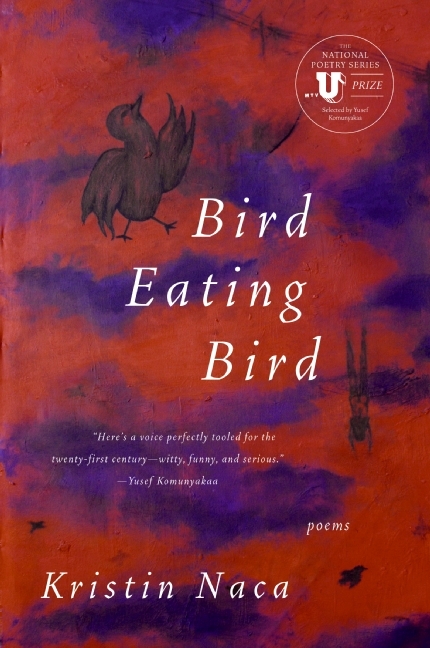
Naca is the author of Bird Eating Bird, a great collection of poetry chosen for the National Poetry Series mtvU prize by Yusef Komunyakaa, the 1994 Pulitzer Prize winner in poetry. Naca teaches at Macalester College in St. Paul, Minn. She was born in Washington D.C. and raised in northern Virginia.

I spoke with Naca in June for a class at Old Dominion University, and will post a couple of excerpts from that talk in the next few days. Today’s post contains her responses to a recent email exchange, and if this “Belligerent Q&A” seems light on my customary foolishness, it may be because the subject will be grading me.

Q: Just who do you think you are? Please use three examples in your response.

  1. A wandering poet
  2. A distracted yogi
  3. A wishful filmmaker

Q: You interviewed Yusef Komunyakaa for a certain cable channel. How did you come to join the international conspiracy to keep music off of MTV?

The liberating thing about conspiracy is the mechanism is shrouded in secrecy. I just do my part. I had been a finalist for the National Poetry Series in 2007, and they let me know a few months prior to the judging. But when I was a finalist for the NPS mtvU prize in 2008, they did not let me know ahead of time. So, I had already let it go. The day I learned about it, I was just really hungry and stopped at Los Robertos in San Antonio, Texas, for a taco when the NPS staff called to tell me I won this cool prize. From that point on, I only do what I’m told. Even going to NYC. Even talking to Yusef and praising his genius and influence. Though, hopefully, some of that’s rubbing off on me.

Uh … Hasn’t it been more than a decade since MTV showed videos? I think it’s time to let it go.

Q: Recently, Wisconsin Gov. Scott Walker cut $2,000 in annual funding for the state’s poet laureate. Additionally, the U.S. poet laureate, presently W.S. Merwin, rakes in a cool $35,000 per year. Why should any American support lavishing such sums upon the arts when the top executives of our nation’s noble lending institutions can barely stay knee-deep in foie gras entier with truffles and prickly pear salsa?

Most people are starving for art in their lives. They don’t understand the water supply has been tainted by giant entertainment industries. So, most Americans can’t fairly judge what they’ve been estranged from. Even though art’s deep inside them. Even though people truly are made of art. Remember regular people are moved to produce art when they’re in love and when they’ve suffered a great tragedy. It’s at those times they recall what’s in their bones. That it becomes clear mundane utterance will not suffice to express the complexity of feeling that makes up their lives.

Also, I wonder exactly who believes art should be de-funded? It’s obviously a larger than life-size gesture about something that’s a pittance to the overall economy – even in Wisconsin. It’s a cultural imperialist’s move, don’t you think? Isn’t meant to dislocate people from their language, from expression. Part of a conversion philosophy that tells us we should be afraid out of our minds about fiscal blah blah blah. And shouldn’t everything go? Art, then public transportation, then homeless shelters, health care, veteran’s benefits, safe food, retirement, and most definitely education.

Q: When is it time to rhyme?

All the time. Rhyme all the time. Rhyme to the time and repeat.

Q. We’ve covered so much ground here. What else would you like to say?

Is it warm in Norfolk? It snowed in Minneapolis again last night. And we’re in a heat wave, a balmy 28.

Boy, the world is full of good sports. Again, a more serious craft conversation will follow. For more information on Kristin Naca, visit her website here.

And if you’re ever in San Antonio, Naca recommends the carnitas taco on corn at Los Robertos.
Tagged , , , , , , , , , , ,

Writing Craft, Vol. I: Mike D’Orso’s “The Project and the Park”


Mike D’Orso and I had a little fun the other day regarding his new book, written with the actor and activist Ted Danson.

I also asked via email about the craft of feature journalism writing. His answers are reflected in this post.

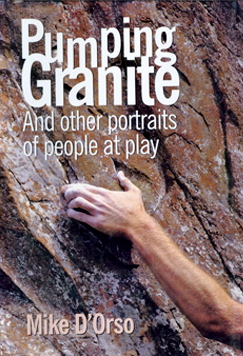
Among his writings, some of my favorites include sports journalism stories from Pumping Granite. A big favorite is “The Project and the Park,” the story of an evening at Tidewater Gardens, the housing project near Harbor Park in Norfolk, Va. Harbor Park was new when the story was penned for The Virginian-Pilot.

Here’s the lede, which instantly establishes two settings, the distance between them, and a main character:

It was an hour-and-a-half before game time at Harbor Park. The bleachers were empty, the grounds crew had yet to chalk the foul lines, but Catherine Newby was already settled into her seat – behind third base, beyond the left field parking lot, across ten lanes of interstate highway.

She’s 63, and has lived in the neighborhood for decades. Mike shows her appreciation for the park – the sound of music from the stadium, the lights in the sky. It’s a lesson in great reporting – not only going to a place and reporting through interviews and observation, though Mike is expert in such things, but also doing the research that allows telling detail within a narrative:

It is not a hopeful place. Nine out of every ten families living in its brick row buildings are headed by a single woman. Nearly half those households have an annual income of less than five thousand dollars. Ninety-seven percent of them are black.

None of which means a thing to Catherine. All she knows is this is her home. Those are her gardenias and petunias planted at the edge of her small concrete stoop. Those are her three metal folding chairs set up outside the screen door of her apartment. And that new stadium, its light towers looming above the traffic whooshing past on Tidewater Drive, is Catherine’s pleasure.

People from the neighborhood recall the story of opening night, as seen from there. There are scenes effectively, but it’s basically the narrative of the visit, interspersed with the game. The difference is a reporter with the ability to listen for great, telling quotes like this one:

‘Oh, what an evening!’ said Catherine. ‘You could hear the mayor, and Father Green, and the Star Spangled Banner. We all stood up and put our hands on our hearts when they played that. We sure did.’

Of course, not everybody is so thrilled, and the story ends with some real tension, and then also a gentle image seems to strike the right note while still being beautiful. I won’t spoil it, since you surely will go buy the book now. Anyways, I asked Mike a few craft questions about that story via e-mail. They follow.

Q: How did you find that story? Was that story assigned or hunted down?

Harbor Park was about to finally open, after months and months of construction, accompanied by dozens of stories about every aspect of the park, right down to how the hot dogs and buns would be shipped to the stadium.

It occurred to me, as I exited off I-264 one day, right by the ballpark, that this stadium literally cast a shadow over the housing project on the other side of the interstate – Tidewater Gardens. I thought about the fact that these people had watched this behemoth grow right before their eyes, and that it was a symbol of the monstrous class-and-economic divide that exists in America today between the ‘haves’ and the ‘have-nots.’ I doubted that many residents in Tidewater Gardens could afford a season ticket – or even the cost of a single game (including the exorbitant cost of concessions at a ballgame). In other words, though these people lived closer to this stadium than anyone, it may as well be a universe away.

Frankly, it also angered me that whenever The Pilot did a story involving a community like this, the reporters always interviewed and quoted the ‘usual suspects’ – a couple of community leaders and local politicians who always ‘spoke for the people,’ rather than approaching and allowing some of the people to speak for themselves. This was certainly the case in the one or two stories The Pilot had done in the previous months concerning the neighborhoods near Harbor Park – including Tidewater Gardens.

So I got Lawrence Jackson, a brilliant photographer with The Pilot at the time (and now an official White House photographer), to join me, and we simply went over to Tidewater Gardens on the night of a home game and roamed the neighborhood from about 5 p.m. (a couple of hours before game time), all the way till the final out was made, at about 9:30 or so.

We just played it by ear, chatting with people we happened upon, talking with them about their feelings concerning the ballpark, and always, inevitably, having the conversation expand into their feelings about their lives in general and about their community.

One point I hoped the story would make, although this wasn’t a stated or intended agenda, was to show that this community and so many like it – which are so often reduced to the broad, sweeping, and negative stereotypes that accompany terms such as “inner-city,” “public housing,” and “project” – is not filled with just crime, violence and poverty, but is also home to people and families, who have the same values, wants and needs as people in any other community … people who care about their neighbors, who take care of one another because so much care is needed and so little is provided, and who, yes, would love to be able to have a seat in that stadium over there and take in a ballgame. If they can’t do that, Lawrence and I found, some of them do the next best thing, pulling a chair outside the front door of their rowhouse, tuning the radio to the ballgame, and enjoying the evening like any other fan, some even standing for the national anthem, just like the people under the lights over there, across the highway. Just normal, ‘good’ people, making the best they can of their lives – that’s what that story boiled down to.

Q: How did you begin reporting it? Did you research the neighborhood or just drive out there?

I always like to do as much research as I can before going out for the actual ‘reporting.’ This gives me some understanding of particular issues, an idea of some issues I might want to explore, and it also gives me a few nuggets of fact that I can sprinkle throughout the narrative – not so many that they bog down the story to the point where it reads like a government study, but enough to illuminate a particular scene.

That old writers’ saw about ‘show, don’t tell,” should actually be “show AND tell,” in just the right proportion.

Q: You use numbers very quickly and very effectively in the story, to make a sort of point that quickly is humanized by shifting back to the people in the narrative. At what point did you gather your statistics on the neighborhood?

As I said, I gather a good amount of statistics before I go out and report. Then, when I come back,  I’ll almost always find myself looking up a specific fact or statistic I didn’t have before, prompted by something seen or said while I was out ‘in the field.’

Q: Why did you think this was an important story to tell?

I think I answered this earlier.

Q: What was the editing process on this story?

Very little, if any.

Q: Did it change from the first draft?

Very little, if any.

Q: Did you outline? Why?

I always outline before I write. I believe it’s always necessary to have some kind of map to follow. Nothing rigid. I ‘outline’ much like a filmmaker ‘storyboards’ his movie. That’s how I arrange and prepare a story prior to writing. I think in terms of scenes, very much like a filmmaker. Once I’ve arranged my ‘scenes,’ I then take my raw material – research, ‘field’ notes, etc. – and distribute it among the scenes, putting this quote or factoid in this scene, and that quote or factoid in that one, and so on. Then I begin to write, always with the flexibility that the scenes might be reshaped, rearranged, or restructured as I go along.

Again, you can learn more about Mike’s writing and books here. And this is the link for his new book with Ted Danson.

Tagged , , , , , , , , , , , , , , , , , ,

Belligerent Q&A, Vol. I: Mike D’Orso


Norfolk, Va., author Mike D’Orso’s new collaboration with the actor and environmental activist Ted Danson will be published March 15.

Oceana: Our Planet’s Endangered Oceans and What We Can Do to Save Them is Mike’s 11th “collaborative book,” and he has written five of his own.

Previous collaborative subjects include former New York Jets player Dennis Byrd, former U.S. Senate Majority Leader Tom Daschle, D-S.D., and civil rights pioneer and current U.S. Rep. John Lewis, D-Ga.

Mike’s working on a memoir and how-to book now. The working title is WITH… : The Long Strange Trip of a Professional “Ghost” Writer.

Mike agreed to answer a few questions by email. Only after he received the questions did he realize there were no backsies.

Q: Just who do you think you are? Please use three examples in your response.

It often depends on the day – sometimes on the hour. At the moment, I am:

  1. A proud father (of my 26-year-old daughter, Jamie)
  2. A 14-handicap golfer (it’s been a long winter–a lot of rust to shake off)
  3. Hungry (it’s almost time for lunch)

Q: Apparently our planet’s oceans are endangered. What can we do to save them?

The first step is realizing the numerous ways in which the oceans are threatened, the extent of those threats, and how truly catastrophic the consequences will be if something (many things) aren’t done and done soon.

There’s no room here to list the dozens of courses of action that we as individuals (not just Americans, but all people), that our government (not just the U.S. government, but the international community), and that the global fishing industry can and must take to stem the tides of overfishing, ocean acidification, marine habitat destruction, insidious government subsidies, and corruption among commercial fisheries that threaten to turn the oceans into nothing but watery deserts within the next half-century.

Q: Regarding Ted Danson, how handsome is too handsome?

I believe the definitive answer is provided in the video found at this link in which Ted, of course, makes an appearance. (About two minutes in.)

Q: If we submerge Oceana: Our Planet’s Endangered Oceans and What We Can Do to Save Them in water, will it expand into a giant sponge shaped like a commercial fishery?

Are we talking sea water or fresh water?

Q: The book lists for $32.50 in the U.S. and $37.50 in Canada. Do Canadians care 15 percent more than do Americans about the oceanic biosystem?

No. There’s a dirty little secret in the publishing industry at work here … it’s called the ‘Uncle Sam Discount.’ (The statute was hidden deep in the pages of the Patriot Act.)

Q: We’ve covered so much ground here. What else would you like to say?

Time for lunch!

If you followed Mike’s link to that video above, and either are a patient individual or reading this at work, you may have realized by the fifth minute that too much handsome cannot save too little funny.

Mike answered a few more questions on one of my favorite journalism stories from his days at The Virginian-Pilot, collected in his book Pumping Granite. I’ll post that this weekend.

A site for the new book is here. Mike’s own site is here.

Tagged , , , , , , , , , , , , , , , , ,

On AltDaily’s “If You Read the Paper”


A new essay is posted at TReehouse Magazine on a great feature at AltDaily, a local alternative news and opinion website in the Hampton Roads, Va., region.

The (week)daily feature is a regular stop for me when I surf online. As the essay says:

(If You Read the Paper) has shown itself to be a flexible, funny, often astute barometer of local news, how it is gathered, and how the gatherers may fall short.

This essay followed up on some reporting (some might say bloviating)  I did about a year back on the local alternative outlet scene, and my hope that they would cover the health, importance and quality of The Virginian-Pilot, our local daily paper and my former employer.

As the essay notes, Jesse Scaccia of AltDaily had a much better idea. Hope you’ll check out the feature, TReehouse (run by former PortFolio Weekly editor Tom Robotham) in general, and AltDaily, too.

Links to some other essays and journalism I’ve written for Tom are on the right rail of this blog.

In other local alternative media news, Jeff Maisey of Veer Magazine, an alternative monthly print pub and online outlet, has launched Afr-Am, a new pub aimed at the African American community.

Haven’t seen it yet, but it’s supposed to be on the stands around town. We had another pub around here called Mix that Landmark, the company that runs The Pilot, did, but it folded.

Tagged , , , , , , , , , , , , , , , , ,

John Kohn benefit


A benefit for the family of the late John Kohn, a local musician and Norfolk police recruit who died following a series of training incidents in December, will be held Saturday — not Sunday.

The benefit is scheduled to begin at 4 p.m. and last until after midnight. It will be held at Shaka’s Restaurant and Nightclub, 2014 Atlantic Ave, Virginia Beach, Va. Cover is $10. Donations are welcome.

Several musicians who have played with John over the years are scheduled to perform in John’s memory. The lineup includes Superock, Nature’s Child, Paper Mountain, Jesse Chong, the Jay Rakes Band, and Vintage.

John is survived by his wife Sarah and a daughter, Sarah, who is on the way, according to an announcement about the benefit. All proceeds go to John’s family.

For those who have followed the circumstances surrounding John’s death, you know the NPD’s handling of information has been, to be charitable, mind-boggling.

But that’s just a sideshow compared to the life John led as a musician and music-lover, in service to his country and, more recently, in his effort to join the men and women protecting the city of Norfolk..

Info is here. (For Facebook users.)

Tagged , , , , , , ,

Martin Luther King Jr. Day


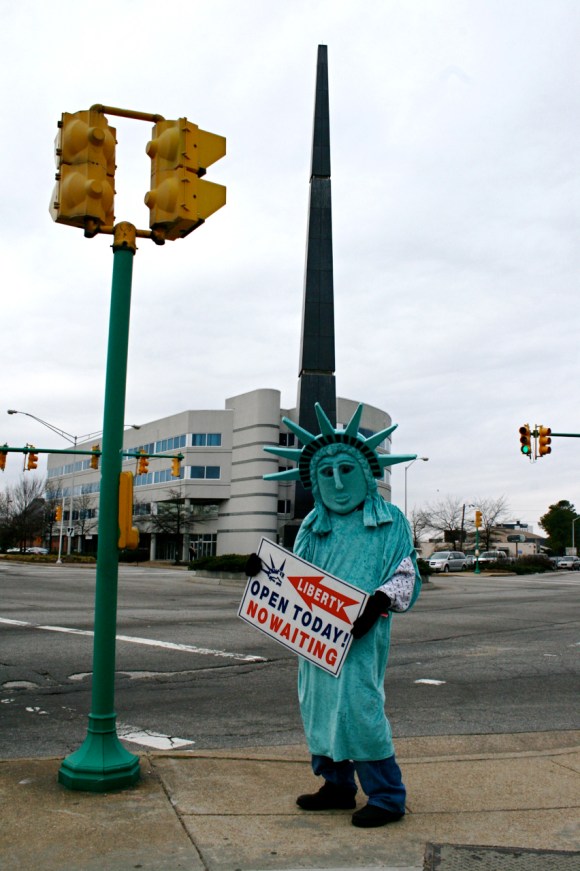
Andre Cousins, 22, works his shift for the Liberty Tax Service branch near Church Street and E. Brambleton Avenue, this morning. Behind him is the Martin Luther King Jr. Memorial. Photo by John Doucette.

Around lunchtime today, 22-year-old Andre Cousins waved to passersby near the intersection of E. Brambleton Avenue and Church Street, in the shadow of the Martin Luther King Jr. Memorial at the center of the intersection.

Cousins, who grew up in the Bowling Park area, was working for the nearby Liberty Tax Service branch. He said he had watched people march to the memorial that morning to celebrate Dr. King’s legacy.

He said:

Everybody came marching down. They joined in a circle, started clapping and waving. Some people started crying through. I went over, did a little dance with them. People came over and took pictures.

When the marchers pressed on, Cousins said he stayed behind to keep working.

I wish I could have gone with them. Black, white, Mexican, all of them were mixed together.

Tagged , , , ,

Selective facts in the NPD version of John Kohn’s death


The reports that came out Friday about what happened to Norfolk police recruit John Kohn, a shipmate of mine aboard USS Theodore Roosevelt many years ago, show the Norfolk Police Department did not tell the whole story of the events that apparently led to John’s death.

Mike Mather’s reporting for WTKR shows John was punched by an instructor during a self-defense exercise. According to Mather, this is several minutes after the collision between John and another recruit. The collision was what the PD initially said preceded “the officer’s distress.” Mather reported:

On Dec. 18, John Kohn, a husband, a father to be, and a rock and roll drummer, died. Yet police did not reveal all the circumstances. Chief Marquis consulted with the city attorney, and according to documents obtained by NewsChannel 3, they decided the chief would: ‘reiterate that the event before the officer’s distress was an accidental collision.’

As you can see from the video released today, that’s simply not true.

Does hitting police recruit John Kohn’s head until he’s non-responsive and then letting the police chief effectively lie for weeks about injuries that may have led or at least contributed to this death make anyone in Norfolk safer? Or make any of the recruits who survive their classmate better cops?

Here’s the video of the collision, which apparently was what the PD initially released. As Patrick Wilson of The Virginian-Pilot reported:

The incident was a full 11 minutes after a collision with another recruit that the police chief initially blamed for his hospitalization.

Compare it what is on the video Mather obtained, and what the police chief said last month:

I am taking this opportunity to reiterate the sympathy of the Norfolk Police Department in the death of Recruit John Kohn.  As you are aware, the department is continuing an industrial accident investigation as is the Occupational Safety and Health Administration (OSHA).

Be reminded that this is not a criminal investigation.  What we do know is that two recruits accidentally collided while moving through the doors of the training area on December 9, 2010 during defensive tactics training.  At the time of the collision, both recruits were wearing full head and hand protection issued by the Department for purposes of the defensive tactics training.  Soon after the collision, Recruit Kohn exhibited signs of distress and was transported to the hospital by Norfolk Fire-Rescue.  Recruit Kohn was admitted to the hospital and subsequently died on December 18, 2010.

We are advised that on Monday, December 20, the Office of the State Medical Examiner conducted a preliminary autopsy and will conduct more comprehensive tests in the near future.  The results of these examinations may yield information concerning the cause of death.  The Norfolk Police Department will not be the source of information for any autopsy results or on the cause of death.  The Office of the State Medical Examiner will determine the release of the autopsy and examination results.

The department will review the information that is made available from these investigations to determine any lessons to be learned.

The chief told The Pilot he did not know about the punches when he made the initial statement. However, by relaying such selective facts initially, and then even for weeks following the statement, the department effectively lied about the events that led to John’s death when the organization had additional information. I’m not sure what anyone who let this happen was thinking.

A clarification after the initial post:

I’ve edited the initial post, particularly the last paragraph and some early language, because I’m told the city complied with the specific requests of at least one media organization in turning over video of John’s training, though that meant only the collision was released. Also, I don’t know how to characterize John’s condition after he was struck. Mather’s story uses “unconscious” and “unconsciousness”, but I’m not sure about that language from what I can see in the video and don’t want to characterize it that way. Additionally, I can’t characterize the training itself (I have not sought to do so). My concern, generally, has been the PD response.

I did not write that the city had not responded to requests, but that they had withheld information (two other incidents involving John, one before and one after the collision) for some time. Precisely how long, and for what reasons, would be nice to know. If officers or recruits discussed the punches with detectives on Dec. 9, as records cited by The Pilot‘s Wilson on Friday indicate, how is it that this information was withheld from the public (and apparently city leaders) for a month?

Additionally, this is from Wilson and Harry Minium’s story today:

(Chief Bruce) Marquis insisted Friday that he did not know about the punches to the head when he spoke to Williams in late December. ‘I was told that Recruit Kohn continued with the exercises, and during the exercises (his unresponsiveness) was noticed by the instructor,’ he said. ‘They advised me that he continued an exercise which involved ground fighting – not specifically that the ground fighting included him getting punched in the head.’

Marquis said he recently became aware of the punches to Kohn’s head but had been advised by the city attorney’s office not to discuss the information. ‘I don’t recall when I learned about the punches,’ he said. ‘The whole punches to the head part of it, as far as my knowledge base, is a recent phenomenon.’

Documents released by the city attorney’s office on Thursday show that Marquis’ top aides were discussing that training instructor Leldon Sapp struck Kohn – the day after the chief released his statement that made no mention of blows.

Sharon Chamberlin, senior assistant chief of police, e-mailed Capt. Paul Galligan: ‘One question will be asked – where was Kohn struck by Sapp?’

‘In the head,’ Galligan replied.

When asked whether he believed his command staff should have informed him of that sooner, Marquis said of Chamberlin: ‘Maybe she should have stressed it more so I could be a little more coherent about that incident and what took place.’


Tagged , , , , , ,