Category Archives: Uncategorized

John Kohn benefit


A benefit for the family of the late John Kohn, a local musician and Norfolk police recruit who died following a series of training incidents in December, will be held Saturday — not Sunday.

The benefit is scheduled to begin at 4 p.m. and last until after midnight. It will be held at Shaka’s Restaurant and Nightclub, 2014 Atlantic Ave, Virginia Beach, Va. Cover is $10. Donations are welcome.

Several musicians who have played with John over the years are scheduled to perform in John’s memory. The lineup includes Superock, Nature’s Child, Paper Mountain, Jesse Chong, the Jay Rakes Band, and Vintage.

John is survived by his wife Sarah and a daughter, Sarah, who is on the way, according to an announcement about the benefit. All proceeds go to John’s family.

For those who have followed the circumstances surrounding John’s death, you know the NPD’s handling of information has been, to be charitable, mind-boggling.

But that’s just a sideshow compared to the life John led as a musician and music-lover, in service to his country and, more recently, in his effort to join the men and women protecting the city of Norfolk..

Info is here. (For Facebook users.)

Tagged , , , , , , ,

Barely South Review features Dennis Lehane


The new edition of Barely South Review is now online, and among its many new features is an interview/essay by Tony DeLateur with Dennis Lehane, author of Mystic River and other novels.

DeLateur is a pal from the Old Dominion University Creative Writing program. He does a nice job walking through Lehane’s general chop-busting of writerly writers and the critics who love labeling, and slides into the advice:

Responding to the aspiring writer’s first great hurdle, the blank page, Lehane simply said, ‘Gut it out…the only answer is the answer that nobody wants to hear: you just have to put your ass in a chair and write.’

And capping his take on Lehane:

Dennis Lehane’s ability to execute intricate, believable stories that rise naturally from characters’ actions has garnered him both success and recognition. In addition to his print work, Lehane was tapped for HBO’s The Wire, a sprawling drama hailed by many critics as one of the greatest television series ever made. Three of his novels have been adapted into feature films. All this is proof enough to certain bitter writers that his work is too universal, too simple. But after hearing this author expertly dispatch preconceived notions about what a “crime author” should value, I left believing that only two types of fiction exist: stories that work – that have journeys which contain drama and emotional depth and action – and those that don’t.

So I hope you’ll read the story, if you dig Lehane or writing in general. The advice is fairly common sense, of course. I just like Lehane.

I also pulled out my notes from Lehane’s talk last year at the ODU Literary Festival, and here provide some high points.

Lehane on Lehane:

I’m a bastard child of pulp fiction and high art.

On writing:

You should always write the book you want to read.

You can’t be an author without being an outsider, a round peg in a square hole.

The relationship when I write is a very intimate and charged relationship between me and an imaginary reader.

If you’re going to write a novel, you’ve got to know how to plot. Tell a story, move it forward, have a beginning, middle and end. … People read for story. … You have to engage the reader in telling a story, and nobody can tell me different.

On when you meet an ass of a writer:

It’s cause they never had friends.

And (though you miss a bit without Lehane’s delivery) on graduate students in MFA programs and such:

I always write 20 pages into a book of a character sitting in a room. You guys actually turn them in.

Tagged , , , , , , , , , ,

Martin Luther King Jr. Day


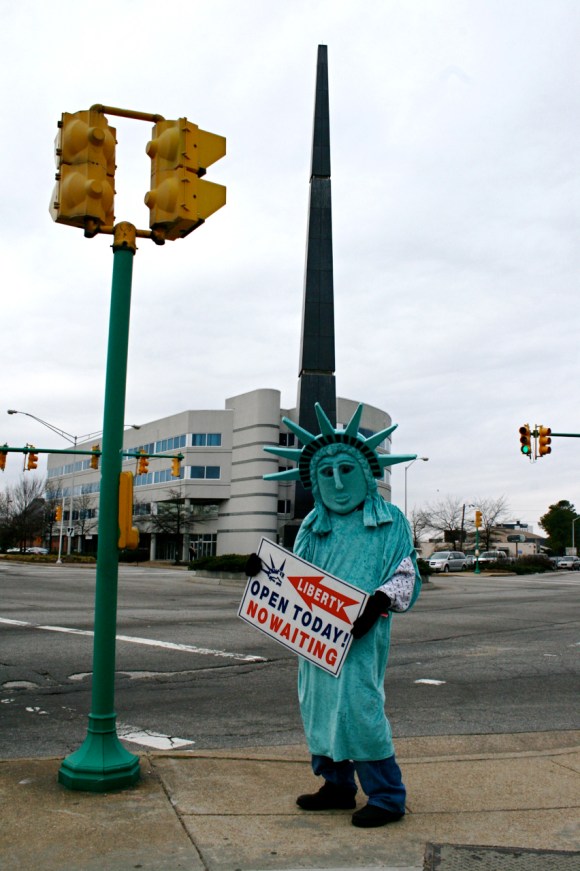
Andre Cousins, 22, works his shift for the Liberty Tax Service branch near Church Street and E. Brambleton Avenue, this morning. Behind him is the Martin Luther King Jr. Memorial. Photo by John Doucette.

Around lunchtime today, 22-year-old Andre Cousins waved to passersby near the intersection of E. Brambleton Avenue and Church Street, in the shadow of the Martin Luther King Jr. Memorial at the center of the intersection.

Cousins, who grew up in the Bowling Park area, was working for the nearby Liberty Tax Service branch. He said he had watched people march to the memorial that morning to celebrate Dr. King’s legacy.

He said:

Everybody came marching down. They joined in a circle, started clapping and waving. Some people started crying through. I went over, did a little dance with them. People came over and took pictures.

When the marchers pressed on, Cousins said he stayed behind to keep working.

I wish I could have gone with them. Black, white, Mexican, all of them were mixed together.

Tagged , , , ,

Selective facts in the NPD version of John Kohn’s death


The reports that came out Friday about what happened to Norfolk police recruit John Kohn, a shipmate of mine aboard USS Theodore Roosevelt many years ago, show the Norfolk Police Department did not tell the whole story of the events that apparently led to John’s death.

Mike Mather’s reporting for WTKR shows John was punched by an instructor during a self-defense exercise. According to Mather, this is several minutes after the collision between John and another recruit. The collision was what the PD initially said preceded “the officer’s distress.” Mather reported:

On Dec. 18, John Kohn, a husband, a father to be, and a rock and roll drummer, died. Yet police did not reveal all the circumstances. Chief Marquis consulted with the city attorney, and according to documents obtained by NewsChannel 3, they decided the chief would: ‘reiterate that the event before the officer’s distress was an accidental collision.’

As you can see from the video released today, that’s simply not true.

Does hitting police recruit John Kohn’s head until he’s non-responsive and then letting the police chief effectively lie for weeks about injuries that may have led or at least contributed to this death make anyone in Norfolk safer? Or make any of the recruits who survive their classmate better cops?

Here’s the video of the collision, which apparently was what the PD initially released. As Patrick Wilson of The Virginian-Pilot reported:

The incident was a full 11 minutes after a collision with another recruit that the police chief initially blamed for his hospitalization.

Compare it what is on the video Mather obtained, and what the police chief said last month:

I am taking this opportunity to reiterate the sympathy of the Norfolk Police Department in the death of Recruit John Kohn.  As you are aware, the department is continuing an industrial accident investigation as is the Occupational Safety and Health Administration (OSHA).

Be reminded that this is not a criminal investigation.  What we do know is that two recruits accidentally collided while moving through the doors of the training area on December 9, 2010 during defensive tactics training.  At the time of the collision, both recruits were wearing full head and hand protection issued by the Department for purposes of the defensive tactics training.  Soon after the collision, Recruit Kohn exhibited signs of distress and was transported to the hospital by Norfolk Fire-Rescue.  Recruit Kohn was admitted to the hospital and subsequently died on December 18, 2010.

We are advised that on Monday, December 20, the Office of the State Medical Examiner conducted a preliminary autopsy and will conduct more comprehensive tests in the near future.  The results of these examinations may yield information concerning the cause of death.  The Norfolk Police Department will not be the source of information for any autopsy results or on the cause of death.  The Office of the State Medical Examiner will determine the release of the autopsy and examination results.

The department will review the information that is made available from these investigations to determine any lessons to be learned.

The chief told The Pilot he did not know about the punches when he made the initial statement. However, by relaying such selective facts initially, and then even for weeks following the statement, the department effectively lied about the events that led to John’s death when the organization had additional information. I’m not sure what anyone who let this happen was thinking.

A clarification after the initial post:

I’ve edited the initial post, particularly the last paragraph and some early language, because I’m told the city complied with the specific requests of at least one media organization in turning over video of John’s training, though that meant only the collision was released. Also, I don’t know how to characterize John’s condition after he was struck. Mather’s story uses “unconscious” and “unconsciousness”, but I’m not sure about that language from what I can see in the video and don’t want to characterize it that way. Additionally, I can’t characterize the training itself (I have not sought to do so). My concern, generally, has been the PD response.

I did not write that the city had not responded to requests, but that they had withheld information (two other incidents involving John, one before and one after the collision) for some time. Precisely how long, and for what reasons, would be nice to know. If officers or recruits discussed the punches with detectives on Dec. 9, as records cited by The Pilot‘s Wilson on Friday indicate, how is it that this information was withheld from the public (and apparently city leaders) for a month?

Additionally, this is from Wilson and Harry Minium’s story today:

(Chief Bruce) Marquis insisted Friday that he did not know about the punches to the head when he spoke to Williams in late December. ‘I was told that Recruit Kohn continued with the exercises, and during the exercises (his unresponsiveness) was noticed by the instructor,’ he said. ‘They advised me that he continued an exercise which involved ground fighting – not specifically that the ground fighting included him getting punched in the head.’

Marquis said he recently became aware of the punches to Kohn’s head but had been advised by the city attorney’s office not to discuss the information. ‘I don’t recall when I learned about the punches,’ he said. ‘The whole punches to the head part of it, as far as my knowledge base, is a recent phenomenon.’

Documents released by the city attorney’s office on Thursday show that Marquis’ top aides were discussing that training instructor Leldon Sapp struck Kohn – the day after the chief released his statement that made no mention of blows.

Sharon Chamberlin, senior assistant chief of police, e-mailed Capt. Paul Galligan: ‘One question will be asked – where was Kohn struck by Sapp?’

‘In the head,’ Galligan replied.

When asked whether he believed his command staff should have informed him of that sooner, Marquis said of Chamberlin: ‘Maybe she should have stressed it more so I could be a little more coherent about that incident and what took place.’


Tagged , , , , , ,

Preventing the snowball effect


New post for Vox Optima on crisis communictions. The post focuses on the recent snow storm in New Jersey. People were trapped in their homes, and some spent the night on the highways. Meanwhile, the governor was on vacation.

A news tax on fast food?


I recently wrote about the issue of subsidies for public-interest news gathering for TReehouse. Though I realize there is little chance such subsidies will be realized given the current political climate, I support the idea as a way to help ensure public-interest journalism remains viable.

AltDaily, an alternative news website in Hampton Roads, Va., has a somewhat related discussion going at its Facebook page about whether folks might support a fast food tax to fund investigative reporting at The Virginian-Pilot.

The discussion, as I write this, shows that some folks do not understand that news gathering organizations, including corporate ones, have historically been subsidized by various forms of government. Some remain so today, both directly and indirectly.

My feeling continues to be that this has not demonstrably been shown to cause an ethical conflict that is in any way different than those conflicts facing news organizations covering corporate interests with which they engage in business relationships. Applying logic and caution might contain concerns about slanted or tainted coverage with subsidies of various types or sizes in place.

The potential for conflict, of course, is great. Potential conflict and realized conflict are two distinct matters. They should be treated as such.

Tagged , , , , , , , ,

Photo: Patriotic Bench in Cradock


Patriotic bench outside the firehouse in Cradock, a community in Portsmouth, Va. Photo by John Doucette.

I shot this as part of research for a story, but it’s not the sort of thing that would get published. I just like the bench.

Cradock is a neat neighborhood. The streets were designed to resemble an anchor, which makes a lot of sense for our communities within Hampton Roads, Va. Some history is available here.

Tagged , ,

Walter J. Ong


I just read “Writing is a Technology That Restructures Thought” for an upcoming rhetoric class at ODU, and thought it was a great essay. Through a framework of considering writing as a technological innovation (of the past) in term of a modern innovation (computers and associated literacy issues), Ong catalogues some of the innovative aspects of writing compared to oral tradition.

Here’s a link to another recent blog post on Ong’s work, from the Ravenous Language blog). The post hits most of the points, and there’s a link to a PDF of the essay.

The arguments he puts forward support my own feelings that written words (generally, in my case, print journalism and essay) are a more specific form of communication that rely upon their own precision to persuade. One can make an imprecise oral argument and persuade, as political rhetoric delivered amid symbolism/symbolic visual and audio cues often does, if only in the moment. From Ong:

By distancing the word from the plenum of existence, from a holistic context made up mostly of non-verbal elements, writing enforces verbal precision of a sort unavailable in oral cultures. Context always controls the meaning of a word. In oral utterance, the context always includes much more than words, so that less of the total, precise meaning conveyed by the words need rest in the words themselves.

Consider that in terms of how a print news story, supported by specific facts and quotes, is delivered (via online or periodical) and processed (by the viewer) compared to how the same story is delivered and processed by cable or local TV news to the viewer. The factual specifics are perhaps less important than is the presentation of specifics. TV news, generally, is delivered in a compressed timeframe and is reliant upon symbols/images/ambient noise as much as words, and most words are spoken rather than written.

From Ong:

Thus in a primary oral culture, where all verbalization is oral, utterances are always given their greater precision by nonverbal elements, which form the infrastructure of the oral utterance, giving it its fuller, situation meaning. Not so much depends on the words themselves. … (T)exts force words to bear more weight …

Tougher to obscure meaning, logic and purpose in writing.

Tagged , , , ,

Photo: Snow Dog


Our dog, Murphy, enjoying the biggest snow our area of Virginia has seen since the 1980s.

John Kohn


John Kohn, a Norfolk police rookie, recently died following a training incident. John and I had been out of touch for a few years, but knew each other in the Navy and while I was in college. He was a wonderful guy and a talented musician. The enclosed/linked song below, recorded on a shoestring for an Old Dominion University student film, features John on drums. I hope you’ll take a moment to listen to him play.