Category Archives: Writing

Writing Craft, Vol. III: Playwrights Jeremiah Albers and Brad McMurran (Part 1)


This conversation in two parts deals with comedy writing, reading, inspiration, criticism, and making an audience laugh.

And a new play. Can’t forget that.

Wanderlust, premiering Friday as part of the Dog Days Festival at the Generic Theater Down Under Chrysler Hall in Norfolk, Va. is the first play written and by the team of Jeremiah Albers, theater critic for AltDaily, and Brad McMurran, one of the leaders of The Pushers comedy group. Albers, too, did his time with The Pushers.

Readers of the blog probably caught the recent Belligerent Q&A with them. If not, give it a try. They bring the funny.

Albers and McMurran also directed the play. Again, it opens Friday, June 17, at the Generic, 215 St. Pauls Blvd., Norfolk downtown. The run is from June 17-19, 23-26, 8 p.m. Thursday through Saturday, and 2:30 p.m. Sundays. Tickets are $10. For more information call (757) 441-2160 or visit the Generic’s online reservation Interbot thingy. Patron under the age of 18 must be accompanied by a “responsible” adult.

This is Generic’s standard, not mine.

The playwrights met while studying in the Old Dominion University theater department before working together in The Pushers.

We spoke at the Colley Cantina in Norfolk for about an hour, and I had to make some hard choices about what to keep in these posts. I leaned toward questions about writing, as this is the supposed thrust of the blog. Point being: thas been edited for length, clarity, and, in cases that should be fairly apparent, language.

One link to/embedded video below contains adult language and probably is not safe for work.

This starts with a question to Albers about joining The Pushers.

Q: You had a dramatic background, but had you done improv?

Albers: No. No improv.

Q: So why did you want to do comedy?

Albers: It just seemed like an interesting thing to do. It was something I hadn’t done before.

McMurran: He turned in probably … in my opinion, one of the finest scripts we had the first season. What we’re doing now, compared to then, is a lot different, because we didn’t know what we were doing. He turned in a beautiful parody of The Vagina Monologues. … It was written by somebody who certainly knew that play. You know, it plays every ten minutes in Hampton Roads.

Q: I think people hear improv and think you get up on stage and make up whatever you want. When I went to my first Pushers show – One of my favorite skits, as I told Sean (Devereux, head writer and producer of The Pushers), was “Justice Crusaders.” It’s just great. It’s written –

McMurran: That was certainly a sketch. It wasn’t until the second year of The Pushers that I went up to Upright Citizens Brigade and went through the whole program up there, and came back and started implementing that into shows. We also used that for writing. Still are. … We found something in New York that I think we instinctually knew, but to put vocabulary to it, “game.” (Finding “the game of the scene,” for example; Upright Citizens Brigade Theatre defines “the game as the single, specific comedic idea that makes a scene funny.”) … I started to notice the pattern of a game. It makes your scene so much better. That’s something that’s gotten a lot better about writing and doing improv.

Q: There’s a really clear pattern of reversals, and not just reversing the expectations of the characters but what the audience expects, and that makes it funny.

McMurran: One of the first things you learn about comedy is one of the funniest things you can do is the unexpected. That’s game. If you’re leading an audience down a pathway to where they think it’s going somewhere and then you – (claps) – flip it on them? They love it.

Q: Particularly the sketch where (Albers) plays Aquaman trying to join the supergroup in the kid’s bedroom or basement or whatever –

Albers: Yeah. It’s kids with a superhero club.

Q: But you play it straight. It’s a tragedy for Aquaman. … Did you have a part in writing it or did Sean write it?

Albers: Sean wrote that one, and he brought that. The key to really successfully acting in comedy is you have to believe it. You have to play it straight.

McMurran: If you don’t play it straight, it’s not funny.

Albers: If you don’t believe it, nobody else will either.

Q: (Albers) left the group. You’ve done some plays. You did a play with CORE Theatre Ensemble.

Albers: A few actually.

Q: And then you’re doing reviews as well. What was it that made you want to write a play?

Albers: It’s something that we’ve been talking about doing since probably the beginning of The Pushers.

McMurran: Believe it or not, this is our fifth idea. We have four other ideas that we want to do. The original idea that we had … is we wanted to write a comedy around Elizabeth and Bloody Mary as sisters, where what that would have been like growing up in that household between the two, but done as a pure comedy. We, ah – we bailed on that project. (Laughs.)

Q: When did you start writing this project?

Albers: March.

McMurran: A little before that.

Albers: February? February.

Q: And when did you have a script?

McMurran: Yesterday. (Laughs.)

Albers: Ask me on the 17th. (Laughs.) No, we actually had a second draft of the script by the beginning of May. We had a rehearsal-ready script. And, of course, we’ve been revising and changing and rewriting as we’ve been going through rehearsals.

Q: What was your process? I haven’t seen the play or read the script. I made the assumption that it’s based (after its inspiration, Arthur Schnitzler’s play La Ronde) on a circular –

Albers: It is. One character from each scene moving to –

McMurran: Yes and no. We have an argument about this.

Albers: It is the same model.

McMurran: I learned La Ronde as an improvisation. It’s actually one of my least favorite improvisational games. However, the crowds love it. It’s something we’ve implemented in The Pushers. The crowds love it. I thought this would actually be genius to write this as opposed to improvising it.

Albers: It was a likely first play for us to write because, I mean, we have experience working together in sketch comedy and so here we have this fully integrated complex play but it’s still done in manageable chunks. From a writer’s perspective, it’s easy to handle that. We have these two characters. Each character has a two-scene arc. Everything is very contained in this model. It’s very compartmentalized, and that has made it very easy us to find our feet as (writers) because it’s not like we were trying to write some complex farce where if we find out we have a problem the whole second act collapsed.

McMurran: I think some of the coolest moments we had were how many natural patterns showed up. Some we intended. Some we didn’t.

Q: One of the things that can happen when you have characters who aren’t on stage for a long time, and have a very limited arc, is they can become types. Is that something that you fought against or embraced?

Albers: Every character in the play is identified by their job. You have a housewife and a newscaster and a squid and a waitress, and the idea is you introduce them as these labels, and you peel that label away.

McMurran: It also becomes our thesis in the play, at the end of the show.

Albers: Yeah. It’s really the main thesis of the play.

McMurran: Are we our jobs?

Q: Why did you set it in Hampton Roads?

McMurran: Write what you know.

Albers: I really philosophically believe that theater has to exist for community that it’s in, and what better way to do theater for your community than to do theater about your community. People are more likely to respond to this than they are to, you know, Twelfth Night. That’s just true.

McMurran: We hope. (Laughs.)

Albers: Although I like Twelfth Night. (Laughs.)

McMurran: I like Eleventh Night better.

Q: There might be expectations for fans of The Pushers that the play will be a certain kind of (humor). What do you think their experience will be?

McMurran: You’re not going to get a play by (us) where comedy is not involved. He tried to fight against me on that a lot. “Brad, this is not a sketch show.”  I’m like, “It should be.” (Laughs.)

Albers: The idea is kind of a play for people who don’t see plays. I’m hoping to get that audience because I think they will be surprised by what they get, but hopefully they’ll like what they see.

McMurran: This might be controversial. I’m so tired of going to plays where it’s people playing for their friends. I would love to get a different group coming in, much like we do with The Pushers. … We went away from the theater crowd. It was one of the best moves that we made, when The Pushers left theaters and went into bars.

Q: Can you describe the change for you?

McMurran: When you go out and play for people who are in the business or in this local Hampton Roads area – and I have a lot of respect for actors in this area, please don’t confuse that, and groups such as CORE; I love CORE – but it becomes more of Our Gang, where we’re going to put up our play, and they put up their play. I had guys who have never seen any live theater come up to me after a show and say, “I never knew it could be this fun.”

Q: One of the interviews I read, you had talked about Tim Conway. Can you talk about him, and … some of the writers, either comedy or dramatic, who influenced you?

McMurran: When I grew up there were two names in my household, Tim Conway and Bill Murray. Tim Conway … I never heard my parents having such fun. They would be losing it, you know? … I didn’t understand the concept, of just watching this little guy get so carried away in these scenes. Just thinking about him in any sketch just makes me laugh. Certainly, probably the first sketch that comes to mind is the one where he’s the old man. No, I take that back. It’s the dentist. The dentist, where he keeps hitting himself with the Novocaine. It’s all physical comedy. … Bill Murray, I think everybody at this table knows I have an unnatural man crush on him.

Q: What they might have in common is there’s pain in their comedy. Especially Bill Murray, there’s a sadness.

McMurran: He’s a very subtle actor. There’s so much more behind the eyes than the normal comedian.

Q: What kind of writers did you emulate or study?

McMurran: I’m a classics guy. When I got put on restriction … I was on restriction every day. I went to Episcopal church in Portsmouth and every Sunday I would do a pratfall after communion. … I’d be put on restriction. My restriction at the McMurran household was you had to go and read classics. … Herman Hess’ Siddhatha is a book I read two or three times a year. And I know I’ll get dogged on this, but I do love The Old Man and the Sea. It’s one of those books that I go back to. And the last one I will have to put on there is The Razor’s Edge.

Albers: I read a lot of plays. Plays are easy to read and it’s kind of an occupational necessity to be familiar with a lot of them. I love all kinds of stuff. Arthur Miller and Tennessee Williams. More modern stuff, I love David Mamet, sometimes. (Laughs.) I will add that caveat: sometimes. Sondheim. I’ve always been really interested in playwriting as a craft because really when you’re acting in a play, which I have a lot of experience doing, you are given this information in front of you and it’s your job to kind of unravel it and get the information out of it that you need to do what you need to do. So I’ve always kind of been fascinated with word choice. I think the best person writing in the theater today, although he’s not really writing anymore, is Sondheim. Even though he’s a music guy, you look at his lyrics and how compact they are, and they’re so clever and they have these crazy rhyme schemes to them, but they’re also brilliant dramatic writing. If you you unfurl them and put them as lines in a play, you could play them as a scene. And I’ve always been really enamored with that idea.

McMurran: One of the writers who has influenced my life is in this play – John Keats. … “La Belle Dame sans Merci” is the (poem) in this play. I’ve never fallen in love with a poet more than I did him. My father turned me on to him. He said, “Hey you ought to read this guy.” I said, “I don’t want to read this flowery guy.” And next thing you know I read that specific poem.

To be continued in part two, which should be posted by early Friday morning.

Tagged , , , , , , , , , , ,

Belligerent Q&A, Vol. IX: Wanderlust playwrights Jeremiah Albers and Brad McMurran


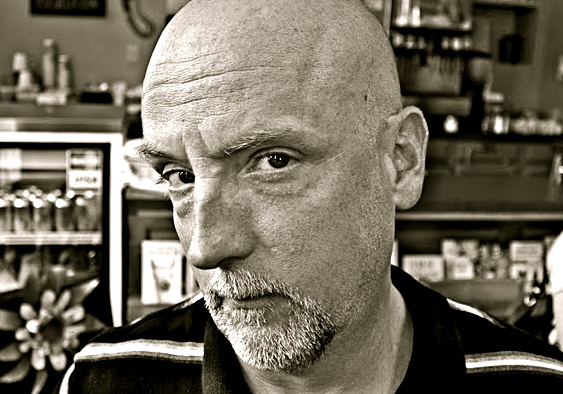
Jeremiah Albers and Brad McMurran, playwrights of Wanderlust. You'll just have to pretend this cutline is funny. Try harder. Yeah. There you are. Photo by John Doucette.

This edition of Belligerent Q&A, to a point, deals with the new play Wanderlust, premiering Friday as part of the Dog Days Festival at the Generic Theater Down Under Chrysler Hall.

Wanderlust is the first play written by the team of Jeremiah Albers of AltDaily and Brad McMurran of The Pushers comedy group. Albers, too, did his time with The Pushers. No surprise then that it’s billed as funny. Word is it’s a bit sexy, too.

Before we get going here, please know that there are some adult exchanges to follow. This Belligerent Q&A is the first sit-down interview I’ve done for this feature. It has been edited for length, clarity and, in spots that should be apparent, language.

Additionally, there is a reference below to a Hampton Roads theater production that was given a negative review by Albers at AltDaily last year. The director of the play rebuts Albers review in the comments section at that link, if you are interested in such things.

Anyway, on with the show …

THE PLAYERS

JEREMIAH ALBERS: A playwright, 33, of Virginia Beach.

BRAD MCMURRAN: Also a playwright, 35, of Portsmouth.

Q: A hapless belligerent interviewer, 37, of Portsmouth, who hoped to author a concise blog post before things went a bit off the rails, let’s say, after the second question.

SCENE ONE

(The Colley Cantina, an eatery and watering hole in Norfolk, jewel of Commonwealth of Virginia’s crown. Q, ALBERS, and MCMURRAN sit down for a Belligerent Q&A, a very disreputable sort of interview. Q aims to supply the Qs. ALBERS and MCMURRAN aim to provide the As.)

Q: Just who do you think you are? Please use three examples in your response.

MCMURRAN: I’m the King of Portsmouth. I have close-knit ties with hipsters on Granby Street. And I think it’s safe to say that I am a lovemaker.

ALBERS: I guess that makes me the Archduke of Virginia Beach.  I am somebody who really doesn’t like tourists very much. And I am an excellent ballet dancer.

Q: You have written something called a play. Is that the one where it’s just like TV, but you have to put on clothes, go somewhere, and once it starts you can’t pause it?

ALBERS: Yes, but you don’t have to wear any clothes.

MCMURRAN: And actually this play, you can pause it. We added a TiVo feature. Only during the naked scenes, like when you were 13. It’s kind of like Trading Places, when Jamie Lee Curtis took off her shirt.

ALBERS: It’s like the old VHS tape where you even put in that part where the movie looks worn from having been paused so many times.

Q: How difficult was it for you to bring to the boards a star-crossed tale of a Christian broadcaster who, through charitable activities, faith, and an association with the 22nd president of Liberia, falls in love with mining African diamonds?

ALBERS: I’m going to say it was pretty easy. That play writes itself.

Q: The venue is the Generic Theatre Down Under Chrysler Hall. Is it on the same level as the (Norfolk Mayor) Paul Fraim clones?

MCMURRAN: Yes. I saw them yesterday, and I made out with one of them. … And I’ll be quite honest with you, Paul Fraim is a big part of this show because, if it weren’t for Paul Fraim, we wouldn’t have really good jokes that are mentioned, I think, one time in the show. … Well, we having dancing Paul Fraims that come out.

ALBERS: That’s true.

MCMURRAN: He comes out and is like, “I’ll take your money and spend it on useless (stuff).” One of my favorite parts of the show. Please come out and see that.

ALBERS: I would just like to add that does turn in to a pas de deux with a mermaid.

Q: (Wanderlust is inspired by “La Ronde” by Arthur Schnitzler.) Presumably using scenes in which a revolving combination of characters interact, with one character’s placement in the following scene creating the thread with which you stitch a circular mosaic of love, longing and humor, you explore the secrets of humanity through the local lens of Hampton Roads. What does that thing I just told you mean?

MCMURRAN: I think it’s better than what we wrote. It’s definitely more well thought out.

ALBERS: I think it means somebody read their CliffsNotes, and maybe actually pasted them verbatim into that question.

Q: How does Portsmouth come off in this thing? We’ve been hurt before.

MCMURRAN: I will speak to this, knowing that I am the King of Portsmouth. It comes off swimmingly. There’s never a punch line about crime. There’s never a punch line about being stuck in Portsmouth. I think Portsmouth has always painted itself in a light it should be painted in. It’s pretty much the King of Hampton Roads, don’t you think?

ALBERS: Yeah. They’re number one.

MCMURRAN: I am from Portsmouth. I am going to say that. So if anybody comes in here and jokes Portsmouth besides us, I’m probably going to put a cap in their (caboose).

ALBERS: But Portsmouth is crime free.

MCMURRAN: Watch yourself.

Q: Did the Chamber of Commerce have any notes?

ALBERS: Well, they did blockade us out of the theater that one time.

MCMURRAN: They know we’re going to be a big money maker for them. … I feel we’ve really gotten a little more support than you’re giving them credit for. Wanderlust is pretty much like the new Elizabeth River Ferry. You know, something you ride back and forth.

Q: I saw the publicity photo of the sailor character. Did you know the Navy gives you a whole bunch of shirts?

ALBERS: Yes. Yes we did. But, you know. Who needs it?

Q: Wanderlust promises theatre patrons “a voyeuristic peek inside the bedroom of your neighbors.” Some kind of furniture thing, I assume. Who has the most tasteful nightstand. Look at the storage capacity of that armoire. That sort of thing?

ALBERS: Yes. Pretty much. The whole thing is being sponsored by Haynes. We’re really excited.

MCMURRAN: And Posturepedic.

ALBERS: Yes. Sealy Posturepedic. It’s been really great for us. Every room is like a showroom at Haynes. And at the end of the show we’re having a silent auction, so you can bid on the furniture.

MCMURRAN: You can bid on the used bed.

ALBERS: Yeah. But it is a Craftmatic. Old people will be comfortable.

Q: Regarding a “voyeuristic peek inside the bedroom of your neighbors,” the scene on my street is a little played out. Could you please help me get a peek inside the bedroom of someone else’s neighbors?

MCMURRAN: It depends on what neighborhood you’re in. Say if you’re down in Virginia Beach it’s going to be a … more heavy neighborhood. I don’t know if you’ve seen how spread out in that area it is, but the only thing there is to do is to go to Wendy’s and go to the beach in a Speedo. If you go to Portsmouth, you’ll probably have to duck from the bullets whizzing overhead. And as far as Norfolk, well you’ve just to get some of those big glasses and fit in with the hipster scene I guess.

Q: What I like is that you’re not trading in stereotypes.

MCMURRAN: Come see this play. There are none in it.

Q: Anything to add?

ALBERS: No. I think he hit it. I don’t want to see my neighbors, either.

MCMURRAN: Plus I think there is a law against being a peeping tom.

Q: That’s good. We’ve learned something.

ALBERS: Knowledge is power.

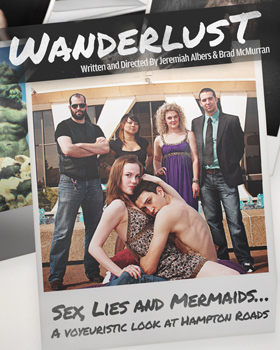
Q: In a cast photo, two members of the company are locked in a passionate embrace outside the Scope, while a quartet of fellow thespians looks on. What did the four spectators do wrong? And what did the other two do right?
MCMURRAN: That’s pretty presumptuous of you to think that two people did something right to be making love right in the middle of Scope. So I think the four that were in the back did something right to not have to make love in front of the fountain – in front of that wonderful architecture called Scope.

ALBERS: Which is aging so well.

MCMURRAN: To answer your question, they probably – I’m not going to say that. I was going to say they could probably lose a few pounds. They’d be fine with that.

Q: And you kind of, in a back-handed way, did.

MCMURRAN: Yes. Of course, I’m very skinny so I can get away with it.

ALBERS: What they did right, I would say, is that they took a pretty decent picture. What they did wrong is that they auditioned for this play.

Q: Brad, you’ve been teaching improv classes for teens through The Muse. How do you get impressionable young people on the right path? By that I mean, how do you get them to avoid mime and popular musicals?

MCMURRAN: I teach them the essentials of life – to live hard, and party fast. I find that that’s sort of the pathway to religious freedom.

Q: The Muse is going to love that.

MCMURRAN: They’ll be fine with that. I’d love to see if I get fired over this interview.

Q: Jeremiah, you’ve done some fine theater criticism for AltDaily. How much better is your play than the dreck you usually have to review around here?

MCMURRAN: This is my favorite question. This is where we get the bad review.

ALBERS: Yes, well, it’s worse, actually, and we did that on purpose. But the sex in our show isn’t done by two dudes playing horses.

MCMURRAN: Although there’s one scene we’re thinking about adding that. We’re having some issues with one scene. That might be the ending we’re looking for. Who knew this … would give us the ending. Equus II: The Return of Love. We’re going to be popular folks. “Come see Wanderlust; they’re haters.”

Q: You both are known for your work with The Pushers. Will Donald Trump’s decision not to run for president put comics and improvisational troupes out of work in 2012?

MCMURRAN: That’s an easy improvisation. Yes. And that is the end.

Q: Anything to add?

ALBERS: I couldn’t have said it better myself. Although I think that some wig companies might be a little sad.

Q: We’ve covered so much ground here. What else would you like to say?

MCMURRAN: Before Wanderlust, I wasn’t a man. This is sort of my turning into a – It’s sort of like Perseus, when he had to go and find his fate. This was that time.

Q: Is that what he did? Found his fate?

MCMURRAN: It depends which way you look at it. Fate sort of found him I guess. Wanderlust sort of found me, too. Although I’m still digging this Equus idea.

ALBERS: Sandy Duncan for president, 2012. Her glass eye will rule them all.

(According to IMBD, Sandy Duncan does not really have a glass eye.)

END SCENE

A (somewhat) more serious craft talk will follow in the near future.

Wanderlust premiers on Friday, June 17, at the Generic, 215 St. Pauls Blvd., Norfolk downtown. The run is from June 17-19, 23-26, 8 p.m. Thursday through Saturday, and 2:30 p.m. Sundays. Tickets are $10. For more information call (757) 441-2160 or visit the Generic’s online reservation Interbot thingy. Patrons under the age of 18 must be accompanied by a “responsible” adult.

Tagged , , , , , , , , , ,

Twelve journalism truths by William Ruehlmann


William Ruehlmann retired this year after 18 years teaching journalism and communications at Virginia Wesleyan College in Norfolk, Va., and I recently wrote about his work here.

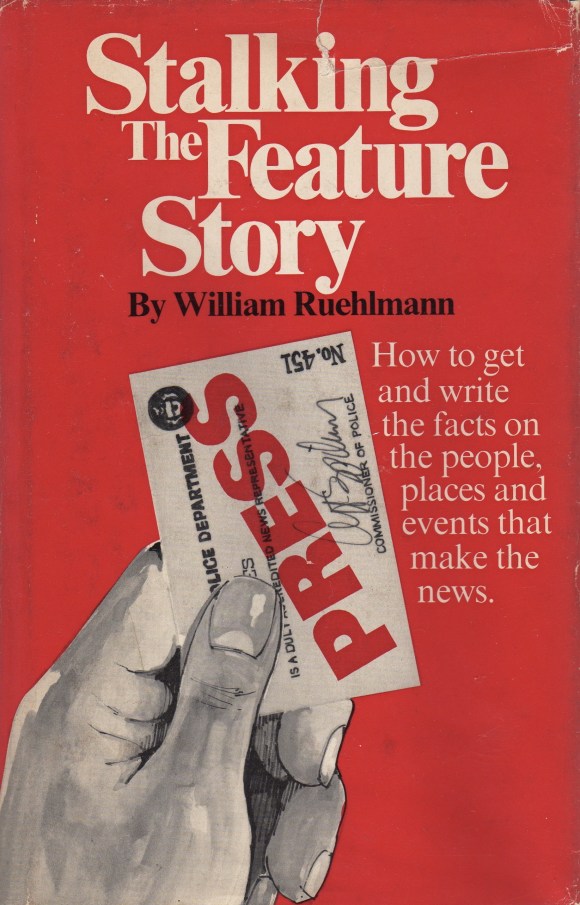
Ruehlmann is the author of Saint With a Gun: The Unlawful American Private Eye, The Feature Story Strikes Back (written for the Society for Collegiate Journalists), and Stalking the Feature Story. The latter is a terrific book about writing and reporting for a newspaper. It has a keen eye toward finding and executing the stories that become great features. It has a spot of honor on my office bookshelf.

I’m not the only fan. A fellow VWC alum recently noted that upon arriving at an internship, an editor handed her a copy of the book. And a reader left a neat comment and a question in the comments of my last post. Addressing Ruehlmann, David Wilson wrote:

Stalking the Feature Story is a book that gripped me way back in 1981, when I was a journalism major at Ouachita Baptist University in Arkadelphia, Ark. After all these years, I keep it on my shelf as one of my favorites on writing. It is definitely among the best. I have a doctorate in educational leadership and work as one of the assistant principals at Jefferson City High School in Jefferson City, Mo. One of the duties I enjoy the most is writing and editing staff newsletters. Your work has helped me tremendously and is much appreciated. Any chance you will be writing another book on journalism?

I put the question to Dr. R. His reply:

(I) appreciate your friend’s approval of Stalking, but no other journalism books planned, though writing will go on in various venues.

You can track down copies of Stalking the Feature Story through sites such as Amazon and Bookfinder, among others. I highly recommend it for those in the business of newspapering or simply writing better stories of any kind. It’s useful. Great read, too.

I recently revisited Stalking the Feature Story, as I have from time to time, and pulled out some cool lines Ruehlmann wrote that are as great and true as anything you’ll find in any other book on writing. These quotes are just a hint of the great professor I was lucky enough to have at VWC.

1. On inspiration:

Read everything. Observe everything. Become earth’s well-travelled eavesdropper. The stories aren’t scarse – they’re too plentiful.

2. On hard work:

The engine started daily runs the most reliably.

3. On reading pretty much everything as research:

That is to say, from now on you are never off duty. Your mind never runs on automatic pilot. In everything you see and read, you are subtly digging.

4. On keeping your eyes open:

What’s worth seeing on the way to work? Simply everything. A world is waiting for those with the eyes to see it; the writer knows that the miraculous happens routinely, the extraordinary is commonplace. … All of this is material. It’s around you, too. You are no longer a pedestrian – you are a witness.

5. On the difference between a writer and a reporter:

If you remain merely a writer – that is, one more consistently at home in the library than on the street – you are not going to get the kinds of stories that matter in this business. You must take the native curiosity of the scholar out into the field and approach the pauper and politico with equal persistence. There will be those who won’t want to talk to you. You’re going to have to go through them to get the story.

6. On accuracy for and honesty with the reader:

If you like to improve on reality and dress up quotes to make a better story, perhaps you’d better get back to that Gothic romance you were thinking of writing.

7. On healthy skepticism:

Trust nobody.

The copy you turn out is your best testimony to the truth, so you have to be very careful what you believe. Even if your sources are honest – and some of them won’t be – they have a way of getting matters mixed up. You’re going to need corroboration to protect yourself not so much from mendacity as from human error.

Legend are the eyewitnesses at the scene of any situation. One will tell you the mugger was a fat man in an Afro who left in an emerald green sedan; another will insist he was a skinny bald guy who escaped on foot. Both are absolutely convinced they are right. Chances are fair the mugger was a woman who took off in a taxi. This is the kind of thing that keeps detectives and reporters amused.

8. On focused, but still expressive writing:

Albert Einstein once explained his theory of relativity to someone on a moving train by asking, “When does the next town get here?”

If it can’t be stated clearly and simply, an idea is not profound. It is merely uninformed.

9. On showing rather than telling:

A writer is a performer who must never ask for the reader’s emotion. He or she must earn it.

10. On economy:

Delete excess.

11. On starting strong:

(W)riting an effective story is like facing a mean drunk twice your size. You’d better get in the first punch, and it had better be a damned good one, or he’ll chew you up. And he won’t even remember in the morning.

12. On finishing strong:

If you want to maximize the force of your piece, the knockout must come at the end.

Tagged , , , , , ,

Belligerent Q&A, Vol. VIII: Earl Swift, author of The Big Roads


You are a saucy one, Earl Swift, Norfolk, Va., journalist and author of The Big Roads. Even when I crop out your tiny brass-studded leather novelty fez. Photo by John Doucette.

I pulled up to Crumbling Swift Manor in Norfolk, Va., in the warm evening air, my pad in pocket, pen in trembling hand. When I knocked, a petite dog announced my visit. Her master approached.

Earl Swift, former journalist and feature writer at The Virginian-Pilot, author of The Big Roads: The Untold Story of the Engineers, Visionaries, and Trailblazers Who Created the American Superhighways. A book with words, many words, words in a certain order of his own design so as to form a story about a topic that people can read after they buy it when it is released on Thursday.

Swift opened the door slowly, yet assuredly. He wore writerly intensity as plainly as a dancer in the All-Cowboy Revue might wear chaps and a red bandana mask. Briskly, we toured the manor house, a parade of wonders – a library containing what could only be called books, a dining room in which meals are eaten atop a table, a kitchen in which food is stored and prepared prior to the very meals that are eaten by people in the house.

Silkily, as he led me through his spacious home, I imagined an imaginary stable boy imaginarily saddling horses that did not exist in the pretend stables. No. Not horses. War-painted camels. Yes.

Those.

And then we were in his office. Where calls are made, a keyboard fingered, electrons spun into nonfiction gold. Overhead, above this hub of composition and concoction, was a handsome chandelier. No doubt his firmest demand of the landlord, made while the imaginary stable boy, awaiting the landlord’s pretend response, trembled, as had my hand, holding my pen in anticipation of this very moment. I demand, he must have said, this Earl Swift fellow, a chandelier above my writing space.

He signed a copy of The Big Roads, blowing gently upon the fiery ink that bore his cursive mark, this signed book so blessed, a prize to be won in the upcoming 2011 Fortune Cookie Fortune Writing Contest, which continues until June 15 at this very swanky online foolishness disseminator.

Or you could buy your own copy. Again, it goes on sale Thursday.

I took in his garb. Rugged. Manly. As though the conjoined lovechildren of L.L.Bean and American Eagle conspired to outfit Hemingway for his last great safari to a public park in Key West. Of course. Swift, who ventured along a mighty Virginia river for Journey on the James and tromped through faraway lands to report Where They Lay, deserved no less. His shorts were khaki, his polo cobalt blue. I announced this finding, much as Jonas Salk must have exclaimed, “I think we got this polio deal licked!”

Swift replied:

This is not cobalt blue. Maybe Columbia blue.

Columbia blue it was. I tried to note the rest of his clothes, but as I bent low to read the words on the back of his adventure sneakers, he spun away, as magically as someone pivoting using a combination of their legs and torso in the holy congress of simple movement. Alas, in determining the needed detail of his wardrobe, my welcome had expired like overindulgent rock star upon regurgitated Jack Daniels.

Point being, this Belligerent Q&A was conducted via email later.

Q: Just who do you think you are? Please use three examples in your response.

You know, if you added ‘young man’ to the end of that question, you could be my mom just after my eighth-grade science project went bad in the kitchen and those things got loose.

Or Sister Mary Michael, the headmistress of St. James Primary School in Twickenham, a suburb of London, where I attended the third through fifth grades and was regularly beaten on the back of my thighs with metal-edged rulers, and yanked to my tiptoes by my proto-sideburns, and where Sister Mary Michael (who had so lavish a mustache that it would arrest the blade of my 6.5-horse Honda self-propelled mower) once thrashed me with the sneaker of a four-year-old.

Or Dennis Tenney, graduate of West Virginia Wesleyan, self-described “song series poet,” and author of The Song of Eisenhower (New York: Whittier Books, 1956), whom I’m confident used the phrase often—though, it must be said, not to me personally.

Q: Your new book is called The Big Roads: The Untold Story of the Engineers, Visionaries, and Trailblazers Who Created the American Superhighways. That’s quite a subtitle. Were there any words left for the rest of the book?

A few. Though I didn’t use them. I’m pretty strict when it comes to the thematic programming of a story. I pick a few notes, and play them over and over. Like in Close Encounters. Only more realistic: I wouldn’t have some French guy running NASA.

Q: You pull the “myth” of Eisenhower as father of the Interstate system apart a bit with your reporting. So didn’t Ike do anything? Like hire a cousin for a paving contract?

I doubt he resorted to cousins. He had an extremely large immediate family, including a number of siblings with interesting nicknames, among which were Bike, and Fike, and Pike, and Wendy.

Ike was busy while president. He made bald sexy as hell; that took time. So did convalescing.

Q: If they make this one into a movie, who would you like to play I-70?

Gene Hackman. He has the reach. I can see him snaking through Glenwood Canyon. Rolling with the Missouri pastureland. And no one else could deliver Wheeling so full-force to the screen.

Q: Since I’ve known you through The Pilot, I’ve admired the way you handle complex subjects and can incorporate a number of sources/characters into such stories in ways that serve the overarching narrative. What does that sentence I just typed mean?

Is ‘overarching narrative’ the same as ‘narrative arc’? Using one of those phrases will get one’s ass kicked in South Norfolk, though I can’t remember which. In case you wondered, that’s why I’ve been avoiding the Campostella Bridge.

Q: Tell me about this Thomas MacDonald fellow. Is he why I can’t get off I-264 at Independence during rush hour? Or was that Herbert Fairbank? Were they the guys who made I-95 suck, especially in Connecticut?

Those men stayed out of Connecticut. Moreover, they forged a pact, early in their working lives, to avoid Rhode Island, as well one might; to get to Boston, they had to drive around. Did you notice my use of ‘moreover’? That’s how you can tell I’m a journalist.

Q: You contend that “we’ll be pumping more money, a lot more money, into the (interstate) network in the years to come” for maintenance alone. Why not ignore it? That seems to be working out great on Social Security.

You raise an excellent point. And remarkably, you raise it in 13-point Lucida Grande. I know of few others who would be so bold.

Q: What was it like collaborating with Ted Danson?

We spent a lot of time on his boat, The Decimator. It had five or six staterooms and a full disco staffed by snug-shirted eastern Europeans. I’m pretty sure most were Hungarian. Plus, of course, the boat’s rigged to pull a purse seine, so the food was great. Ted’s an excellent actor and a fine influence on young people. And when it comes to Pilates – I mean, he could turn professional.

Q: How do you like being interviewed by people who have not read the book?

What did you think of that one part where Ike eats the lemon meringue with his hands? It continues to surprise me that the incident had such a lasting effect on our infrastructure.

Q: Why should we read your book, which all its facts, research, perspective, and storytelling, when there are other books that won’t challenge my assumptions that everything is totally cool, that the landscape hasn’t been that radically changed by the de-centering of communities into suburban sprawl, and everybody just chill don’t worry about it we got a Chipotle coming in near the Wal-Mart?

Are you sure? Is the Chipotle really coming? I’d heard rumors. Man. You’re positive? Hold on a minute. I have to make some calls.

Q: We’ve covered so much ground here. What else would you like to say?

It’s always a pleasure to talk craft with you.

I’ll follow up with a real craft talk with Swift in the near future.

Some early reviews are in for The Big Roads, including this one by Jonathan Yardley for The Washington Post and this one by Patrick Cooke for The Wall Street Journal. Locally, the book is in stock at Prince Books in downtown Norfolk and will be available at other fine local bookstores.

Tagged , , , , , , , , , ,

Language, lines and listening


The following post isn't really about Ted Danson, but it is kind of/sort of, and people seem to like looking at the man, so here is a picture of him. Photo by John Doucette.

This post is about priorities, if you bear with it.

As both who read this blog know, the actor and activist Ted Danson and Norfolk, Va., author Mike D’Orso recently spoke and signed books at Prince Books. The talk was moved across the street from Prince to the Selden Arcade in downtown Norfolk due to anticipate demand. Good thing. Nice turnout.

Danson and D’Orso are authors of Oceana: Our Endangered Oceans and What We Can Do to Save Them. I’ve written about the book and D’Orso before, and previous posts can be found here. The book’s website is here, and you can find links to some nice interviews with Danson there.

I’m not really going to get into the talk here, but I want to share two experiences – one I had, and one someone else had – the day Danson and D’Orso spoke.

In one case, a guy did not understand the concept of a line for the book signing.

By the line, I mean a formation of human being as a mutually agreed-to organizing principle amid a common activity. This is the third most important thing that distinguishes us from the beasts. The first two most important things are (1) language and (2) counting. And let me just list them with a couple other priorities for perspective:

  1. Language
  2. Counting
  3. The line
  4. Thumbs
  5. Isabella Rossellini

This is not to say language and counting are all that superior than the line. An argument could be made that we have language and counting mostly to tell people what number they are in the line. A sad, sad argument.

But say a line jumper gets snippy, you give them the thumbs as a way of demonstrating where they should be in the line. That’s a benefit of thumbs. I’m not about to get into doorknobs here, but certainly thumbs matter there. Also getting a pickle out of a jar. And so you have something to sit on during business meetings. Thumbs: another topic for another day.

The Isabella Rossellini thing is just and oh-by-the-way. Maybe you show them a picture of her to try to calm them down. I don’t know how the lady works, but she works.

So back to the guy and the line.

Lucy Couch, who works at Prince Books and is married to my fellow Old Dominion University Creative Writing MFA-er Ian Couch, apparently had to deal with a disgruntled gentleman with an implied past military affiliation, and an aversion to waiting his turn.

As I understand it, Lucy used language and indicated counting, but the guy wouldn’t have it. Dude just wanted a moment with Ted Danson. Right then. So if this disgruntled guy really had a past military affiliation, I’m amazed he couldn’t out-wait a little line or, say, buy a book maybe on account of it being a book signing at what is a book store, not some subsidized program to bring a bit more Danson to the masses.

This line simply was not some soul-crushing thing. When I was in the service, I’m pretty sure I waited in longer lines to eat chow more than once. And if I tried to jump the chow line? Out came language and thumbs.

Overall, this was a really cool line, with more folks seemingly interested in the environment than they were in how Danson used to be on a TV show called Cheers. Even the guy who asked about a Cheers reunion didn’t belabor it. Much. And some of us were there for D’Orso. This is Norfolk. He’s our guy.

So some guy was a jerk, and Lucy had to deal with it. Lucy held her ground, and he split.

Yay Lucy.

Boo some guy.

That’s the part that happened to someone else. Next is what happened to me.

Earlier, I’d ducked into a business. Through the mutual application of language, two seasoned gents learned where I was going and promptly busted Ted Danson’s chops for a prediction or statement he made many years ago about the oceans’ future – one Danson addresses in the book, by the way. And the men, as though channeling the talk radio drones that ripped into Danson at the time, had a nice laugh.

Though, to be fair, they liked him on Cheers. And Damages.

This reminded me that when I’d read Will Harris’ piece for The Virginian-Pilot on the D’Orso-Danson event at Prince, a couple of online commenters had raised the same points that spoke nothing of the merits of the science Danson is trying to put forward for our consideration.

Now, look: if you’re from Hampton Roads, you know that encountering the reader comments at Pilotonline.com should only be done in a cautionary way, to remind one to drive defensively.

Some of those people own cars.

But it also reminded me that there are a lot of people who seem to exist only to belittle ideas.

To some people, your words are useless and they don’t want to see the math. They don’t give a damn about lines, whether they exist for a reason, right or wrong. They want what they want when they want it, and they don’t care where it comes from, how it was gotten, and what it costs in the long term for short-term gain. You can point them to reality and they’ll say you don’t have the right to give them the thumbs.

What’s left? Help us, Isabella Rossellini – you’re our only hope?

I don’t know that a book changes how some folks are, no more than a silly blog post. I’ll read what Danson and D’Orso wrote, and so will some others, but I already make decisions about my seafood and where I shop and so forth. Maybe I’ll make better ones. Maybe not.

But I’ll try to keep an open mind. I wish more people would try. Ignorance, as it has been said, is not a sustainable position.

Some won’t consider that there’s any value to regulating overfishing by commercial fleets and protecting coastal environments and what have you because, well, they just won’t. At that point, they’re not in a conversation but in a bunker.

I’m kidding around when I say some actress is one of the key things that separates us from the beasts, and my list above, admittedly, is 99 percent bunk. But I’m convinced that language is the key to our humanity, both the written and spoken words. How we add to the pile of existing language defines us.

Part of that is listening. We need to understand the disagreement and the common ground before we speak and write. If we aren’t willing to listen to others, if we always put ourselves first, we can’t communicate. That means we’re incapable of collaboration and compromise for the common good.

That’s inhuman, and it’s scary that any of us find that condition acceptable. It’s even scarier that we sometimes don’t even realize we are actively refusing to hear truths that challenge our own.

P.S. Why can’t we count on Isabella Rossellini alone? She’s busy with um, specific topics, and the following video is (a) nutty and (b) probably not safe for work.

Tagged , , , , , , , ,

Fortune writing contest party, exhibition July 1 at Kerouac Cafe


Winners for the ongoing 1st Annual Fortune Cookie of the Damned Fortune Writing Contest will be named Friday, July 1, here on the blog.

Additionally, the winners who can make it will get their prizes during an informal gathering at Kerouac Cafe in Norfolk, Va., at 8 p.m. that night. There will be a mini-exhibit of the winners. Most – if not all – of the entrants will be on display.

And I will give a 30 minute interpretive dance performance entitled “Deny Me Not My Shasta.” Oh, wait. I will not do that.

We will have a little party, though, and it will be driven by a perfectly legal psychoactive stimulant called caffeine. We’ve got a chunk of wall reserved, so keep those entries coming.

Well after our communal kidneys deal with all that coffee, this breathtaking exhibition of writing and visual art genius will remain up for a whole week, so you’re covered if you just want to run by Kerouac Cafe to hoist a cup of joe and gaze upon a chunk of wall until the tears of eternal wonder come and go and come again.

Again, the gathering is at 8 p.m., Friday, July 1, at Kerouac Cafe, 617 W. 35th St., Norfolk. Free admission. Coffee, tea, lattes, iced drinks, and some eats will be available for purchase.

Festivities will last no later that 10 p.m., largely because I am not as young as I used to be. But feel free to come earlier and stay later. Kerouac Cafe appreciates your business.

Several entries are already in. They come from as far off as Chesapeake, Va. Can Suffolk be far behind? I think not. Can I hear you Williamsburg? You bet I can. Gates County, N.C.? Will you bring it like the postman, Gates County? Hello? Oh, nuts.

Tagged , , , , , , ,

Belligerent Q&A, Vol. VII: Vivian Paige of All Politics is Local


Vivian J. Paige, left center, and members of the Virginia Democratic Intramural Coed Soccer Team form a wall to block a free kick by Commonwealth Republicans United. Boy, these guys get happy when it comes to blocking free kicks. Courtesy photo.

Vivian J. Paige started her blog, now called All Politics is Local, five years ago with an eye toward Norfolk, Va., politics. She’s got experience in the matter, having run for local office. Paige is also a co-founder of Norfolk United Facing Race, a non-profit that hosts honest dialogues on race, and has been in leadership and advisory roles in many organizations, including the Hampton Roads Center for Civic Engagement.

Plus, a day job – president of the accounting firm, founded in 1986, that bears her name.

Point being, she’s busy.

Her blog covers a lot of ground, due to Paige’s interest in a wide variety of social and political issues, and also due to the inclusion of a relatively new stable of contributors – The Virginia Gazette’s Steve Vaughan, Norfolk City Councilman Tommy Smigiel of the 5th Ward, and Navy vet and retired land surveyor Mark Brooks.

Paige is among a small handful of bloggers who set the standard in these parts, and her thoughtful and passionate prose can also be found in The Virginian-Pilot’s op-ed pages. So I’m thrilled she agreed to lower herself to my level for a few silly (and a few not so silly) questions.

Before I launch into our email exchange, I’ll quote from a blog post from 2006, when she wrote about a “debate” on the so-called “marriage” amendment that ultimately passed in Virginia. She pulled no punches. An excerpt from “Bigotry ” follows:

It was like a KKK rally, only the folks under the hoods were black.

Blinded by bigotry, these folks used the Bible as justification for their position. I see absolutely no differences between the claims made by these black bigots and similar claims made by white bigots to justify discrimination against blacks. Of all the groups who should just get this, it should be blacks. After all, it is not as if gays are unknown to the black church. In my home church – the one where my father was ordained in 1946, the one that I grew up in, the one that my family still attends, where my brother-in-law is a deacon and my sister a deaconness and a member of the choir – every prominent family had at least one gay member.

Blinded by bigotry, these people are unwilling to acknowledge the effects of this amendment on their own families, on their friends, on their co-workers. Blinded by bigotry, these people would rather focus on running gays out the state than worrying about things such as the breakdown of the black family, the crime in black neighborhoods, and the high unemployment.

‘Protect marriage,’ they say. From what?

Powerful stuff. On to the Q&A:

Q: Just who do you think you are? Please use three examples in your response.

  1. A lifetime constituent of President Bartlett
  2. A washed up Julie London wannabe, and
  3. Mom to Tommy and Fluffy (and Kelly, Rupert, Sweetness, Samatha, Junior, and Lucy, of blessed memory)

Q: Did you have “found guilty of extortion and bribery + will appeal according to lawyer” in the former state Del. Phil Hamilton Federal Trial pool? I had “jurors and alternates hit by comet + reanimated dinosaur eats incriminating emails resulting in mistrial,” which would have paid out at 1.3 billion to 1. You know, I liked my odds until the other thing happened. Discuss.

Actually, I did have the “guilty + appeal” in the pool. It really was a no-brainer once the emails became public and Old Dominion University officials were granted immunity to testify against him. I suspect Hamilton will get a long sentence  – with most of it suspended. The Justice Department seems to be looking to make an example of him. And I predict he’ll lose his appeal, but that’s a long way off.

Q: You’ve offered up prime real estate your All Politics is Local blog to other contributors, including a member of Norfolk City Council. Are you worried the council will try to build a virtual pro hockey stadium there now that they have an in? A bit more seriously, will you make any considerations, such as offering “equal time/space,” to anyone who runs against Smigiel?

Pro hockey? Um, no. But if they offered a virtual pro football stadium, I’d probably give them all passwords.

As for equal time for a challenger to Tommy – no. While Tommy and I don’t agree on everything, he has my support. And I can’t imagine that a challenger would ever earn that.

Besides, for the low, low cost of $0, anybody can start a blog at WordPress.com.

Q: Why would anyone want to be vice mayor of Norfolk?

To preside over events – like ribbon cuttings – when the mayor can’t? That’s about the only reason I can think of.

Q: You’ve written extensively about how citizens can track campaign finance and the redistricting process and other issues, including gay rights matters such as the so-called “marriage” amendment/legislative efforts. The vast majority of people, however, just don’t seem to get involved with (a) local government or (b) critical thinking on how certain processes work and/or affect others? Why do you bother?

Because it is important. We can’t get better government at the top until we get better government at the bottom. And we have such tremendous influence at the local level, far exceeding any we will ever have at the national level. Besides, a lot of those folks we see in Washington started out in their local offices. The chance to get to know them – and help them develop into better elected officials – is much greater at the local level.

Q: So what you’re saying is you’re in it for all the sweet blogging money, yes?

Ha! Blogging costs me money, not the other way around. Thank goodness for the day job.

Q: Will you run for office again?

Maybe. Or maybe not.

Q: I’ve been interested in the evolutions of outlets such as AltDaily and Veer, as well as established local blogs such as All Politics is Local and Bearing Drift. What news sources do you follow in addition to the local newspapers? And who do you avoid reading?

I’m a Twitter addict. More than three or four hours away from it and I’m going through withdrawal. I follow about 400 Twitterers, a lot of them news outlets, both local and nationwide. If I avoid any, it’s Fox News and the Huffington Post.

Q: We’ve covered so much ground. Is there anything you’d like to add?

Just one thing: when are you going to grace us over at All Politics is Local with one of your awesome articles?

Uh, I’ll get back to you.

Right now I’m tied up with the hack stuff.

Tagged , , , , , , , ,

1st Annual Fortune Cookie of the Damned Fortune Writing Contest


On behalf of the Imaginary Board of Trustees, it is my honor and privilege to announce our 1st Annual Fortune Cookie of the Damned Fortune Writing Contest.

In this test of skill and conciseness, readers contribute (hopefully) clever fortune or fortunes of their own creation to me via email to jhdouc@verizon.net – not in the comments, please – and I take them and turn them into clunky, iPhoto-ed fortunes, such as the one above, and republish them here.

I’m looking for funny fortunes. Clever fortunes. Poetic fortunes. Silly fortunes. Sad fortunes. Angry fortunes. Your hopes and dreams, your fears and foibles. Whatever way you want to approach it. It just has to fit on a fortune slip, so please keep it to about 30 words or less. I’m open to cartoons, photos, or artwork, even – it just has to fit into a fortune cookie fortune sized space. For example, a font freak might go with this:

There will be modest prizes of my choosing, including first-edition, signed books by authors previously featured on this blog. Three winners will get prizes. I’ll probably publish more than three fortunes, but if you aren’t one of the three winners identified specifically as winner you won’t get a prize. I’m not saying you’re not a winner. Because you’re a winner. You just may not be a winner in this contest. Respect to the math.

If I get enough good entries, I’ll post a bunch of them here. If I don’t get any entries, we’ll just get on with our lives and pretend this never happened. Won’t speak of it. Won’t betray the shame. Won’t even make eye contact. Like after that thing in the summer of 1996.

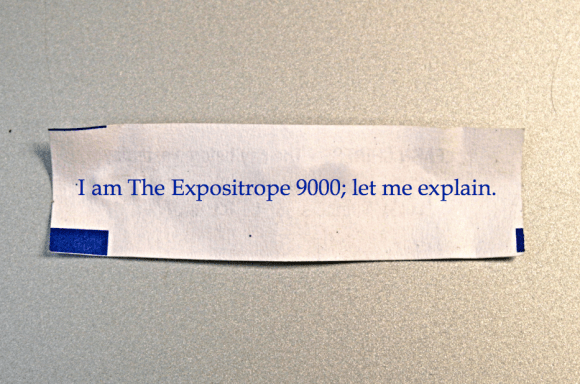
The Imaginary Counsel to the Imaginary Board of Trustees would now like us to mention a few things under the banner of housekeeping. I now turn this post over to The Expositrope 9000, keeper of helpful information, boilerplate and disclaimers:

Greetings, Readers. I am The Expositrope 9000, keeper of helpful information, boilerplate and disclaimers. Confused? Let The Expisitrope 9000 explain. Ha ha ha. That was a joke.

Here is another joke. I, The Expositrope 9000, just flew in from Reno. Golly, are the arms of The Expositrope 9000 tired. Ha ha ha. I, The Expositrope 9000, do not hear you laughing. I, The Expositrope 9000, wonder if this imaginary microphone I am pretending to hold is on.

Now I, The Expositrope 9000, will now relay the rules of entry:

  1. All entries must be received by 11:59 p.m., June 15, via email to jhdouc@verizon.net. That’s the only way to enter. Comments are appreciated, and you can leave as many or few as your puny human flesh can handle, but those will not be considered for the contest. On this, I, The Expositrope 9000, am firm.
  2. Please include your name as you want it to appear on the blog, as well as what you do for a living, and your town and state of residence. Understand that this information may be published along with your entry.
  3. If you have a problem with having your hometown or full name on the blog, please include this in the email containing an entry/or entries. The Internet can be a scary place. Just let the author of this blog know.
  4. Submit entries in the text of your email to the author of this blog via jhdouc@verizon.net. You may submit by emailing files in the .doc, .docx, or .pdf formats. Please enter artwork in the .jpg or .png formats only. If you submit artwork in the .pdf format, it will lose a generation or two before it reaches the blog, and therefore will look lame.
  5. By entering, you agree to let the author of this blog publish your fortune, giving you and your fragile human ego full credit.
  6. As odd as it may be to state amid a come-on for such an unoriginal contest, please don’t plagiarise. The author of this blog tends to check for that sort of thing.
  7. This blog is for what puny humans call fun. This contest is for fun. Please keep it in that spirit.
  8. If you are related to the author of this blog by blood or marriage, you can’t win a prize, but you can still have a fortune published. I, The Expositrope 9000, hereby explain to you that the author of this blog is married, and has been for some time. You snooze, you lose.
  9. There will be three winners, all chosen by the author of this blog. It is totally subjective. Know that going in. Heed me, puny  bags of meat and bone. I, The Expositrope 9000, speak truth!

I, The Expositron 9000, will now relay the Rules of Civility:

  1. Don’t attack an individual, unless it’s the author of this blog. If that’s your bag, at least be funny about it.
  2. Please don’t use curse words. I, The Expositrope 9000, am not impressed by your potty mouth. I, The Expositrope 9000, have heard it all.
  3. No fortunes that are profane, sexually graphic, racist, etc., will see the electrons of day here. If you wouldn’t say it to your mom, don’t send it; if you send it anyway, don’t expect it to be acknowledged. If your mom is a bigot, think about what you would say to someone else’s mom so long as this other mom is not a bigot.
I, The Expositrope 9000, will now relay gratuitous exposition unrelated to the contest at issue above:
  1. There is so little that is known about Agent X. You might say he is a mysterious fellow with unclear motives … at least for now.
  2. Agent X makes his own rules by taking your rules and breaking them … emotionally. What a mysterious fellow with unclear motives.
  3. What could Agent X possibly want with our large pharmaceutical and venture capital conglomerate? Could it be the runoff at Sunny Creek? Could that be it? Boy. How does he know?
  4. Could it be that he is from there? Hand me that high school year book that happens to be on the table. Thank you. Flippity flippity flip. Gasp. No. It can’t be. It’s him. It’s really him. It’s Agent X. There, in the marching band photo. Sunny Creek High, Class of ’01!
Tagged , , , , ,

William Ruehlmann, journalist and educator, retires from VWC


Dr. William Ruehlmann, a journalist and author who taught at Virginia Wesleyan College for 18 years, gives a wave and a smile. Photo illustration courtesy of Meghan See/The Marlin Chronicle.

Stories do not come to the writer. He must go out and meet them, and when he encounters one he must fasten himself to it like a fat man on a free lunch.

— Dr. William Ruehlmann, Stalking the Feature Story

William Ruehlmann is an educator, a journalist, and the author of two terrific books, Saint With a Gun: The Unlawful American Private Eye and Stalking the Feature Story. For the past 18 years, he’s been a professor at Virginia Wesleyan College, teaching young people how to contribute to the world through writing and reporting. At VWC, he’s been the guiding force behind the award-winning campus newspaper, The Marlin Chronicle, and a longtime national leader in the Society for Collegiate Journalists.

He’s retired from VWC, which is why I am writing this. I was one of the fortunate students who gained practical knowhow, inspiration, and even a much-needed senior year kick in the behind from him. Students saw him off May 6 at the college, in a hospitality suite in which a projector showed picture after picture of an educator surrounded by his students. Naturally, we took more pictures.

I studied U.S. history at VWC after I got out of the Navy, but I spent a fair share of time with the communications students and contributed a few columns to The Chronicle. I remember discussion of reporting, fact-checking, ethics, and structure with Ruehlmann. His trust in students to make decisions when covering difficult topics. And how many of the stories written for his classes – rewritten and sometimes re-reported after his notes (always in green, as it is a less punishing color than the dreaded red pen) – were among the first that got me noticed by The Pilot.

I remember learning from Ruehlmann that writing, perhaps especially journalism, isn’t about the writer, but about the subject and those who will read what you write about it. In Stalking the Feature Story, he wrote:

Some egocentric scribes just can’t seem to prevent themselves from popping in and out of their copy like ‘Tennis anyone?’ types in midcentury melodramas. They interpose themselves between the reader and the subject, setting up a picket fence of I’s across their page.

Stay out of the story unless you affect it in some crucial way. Keep your eye on the material, not the mirror.

He led me to that water, anyway. I’ve tried to be as good as can be about drinking it.

Ruehlmann has a way of making the tough lessons a bit more tender. He is one of the first of many mentors and friends who have helped me learn that writing is something you need to feed in return – with fact, with judgment, and voices other than you own. When you get out of the way, and write at the service of the story, writing fulfills the writer. Better yet, it probably gets read and fulfills the reader.

Writing for Ruehlmann’s old paper, The Pilot, I returned to VWC in 2006 and spent time with The Chronicle staff while they made decisions about their coverage of a great tragedy, the murder of a security guard at the campus. Young journalists, many of them feeling the crime so profoundly, carefully consider each and every word they would publish. The decisions were to be their own decisions, with only the gentlest of guidance from their mentor. I remember a line from their editorial:

We are changed.

This past month, The Chronicle carried the news that Ruehlmann was retiring. The man ain’t done, The Chronicle reported. He’ll travel. He’ll keep writing his book column for The Pilot. He’ll write.

Ruehlmann, asked what he would miss about VWC, told The Chronicle‘s Kaitlyn Dozier:

The students. Unequivocally, absolutely, and entirely. I look around this newsroom, at the hundreds of students I have loved and who’ve loved me back. Yes, I will miss them greatly.

Meghan See, editor-in-chief of The Chronicle, told Dozier:

But he wasn’t just a good professor. He taught more than just classroom material. He showed me how not to be afraid of voicing my opinion, uncovering the truth, and sticking up for something I believe in. I honestly think that without Dr. R, I wouldn’t have uncovered my passion for journalism. I often catch myself thinking, what would Dr. Ruehlmann do?

I had a bit of a smile on May 6, when amid the party I first saw The Chronicle‘s report on Ruehlmann – the story of the heart and soul of that paper ran downpage, below the fold. The staff had led the edition with the new student government officers, a room squeeze, and so forth. You know – the news of the community.

Chances are, Ruehlmann would not agree that he was the heart and soul of The Chronicle. Were this post on paper, he’d probably write a note right here (in green, of course) about how it’s the students who breathe life into their newspaper. He might mention later, in the hall or as we passed on the wide field near the chapel, that the editors of The Chronicle played his story just right.

Ruehlmann taught classes called Advanced Newswriting and Feature Writing and what have you, but what he taught all along were judgment, skepticism, open-mindedness, passion, freedom, and that there is truth, or sometimes truths, that must be discovered and shared.

Tagged , , , , , , , , , , , ,

Belligerent Q&A, Vol. VI: Columnist Mike Gruss of The Virginian-Pilot


Would you buy tapioca from this man? I did, and how. Now I have too much tapioca. Thanks a lot, Mike Gruss, features columnist at The Virginian-Pilot newspaper in Norfolk, Va. Courtesy photo.

As the columnist for The Daily Break – feature – section of The Virginian-Pilot newspaper, Mike Gruss has been followed around by a ringmaster. He has compared a Jeopardy champ to one of America’s famed wearers of the John Henry name. And he has written with wit and heart about the things that make the Hampton Roads, Va., region a great place to live, even when our local governments appear to be in a stupid contest.

And he does this three times a week, even. Not too shabby.

Gruss was kind enough to agree to answer a few questions via email. As always, there were no backsies.

Q: Just who do you think you are? Please use three examples in your response.

  1. Alex Trebek. Wait. That’s probably what everybody says.
  2. Do you remember that one scene in Field of Dreams? No, not the one with Kevin Costner. No, not the one with James Earl Jones. Right, Burt Lancaster as Moonlight Graham. Now remember the guy who sold the unnecessary hats to Moonlight Graham’s wife. That’s who I like to think of myself as.
  3. Also, former William & Mary quarterback Lang Campbell.

Q: Tell us about this newspaper technology all the kids are talking about.

Ayech-tee-tee-pee-colon-backslash-backslash-doubleyou, doubleyou, doubleyou, dot, pilotonline, all-one-word, dotcom, slash, gee, are, you, ess, ess. Or facebook.com/gruss. Or twitter.com/mikegruss.

Q: Until a recent misunderstanding, I savored dressing like a ringmaster and repeating people’s orders in the cafeteria of the bus station at Granby Street and W. Brambleton Avenue. Naturally, I enjoyed your recent excursion with Ringling Bros. ringmaster Brian Crawford Scott, who, for a living, trades in what someone with a tendency to misapply musical terminology might call in relievo: “Your literary genius will be eternalized.” Can you explain the experience? And how did you look in that jacket? Be sure to speak up.

Brian was a great hype-man. The energy and language he brought to the most boring tasks we presented him far exceeded my expectations. Having him trail me for a couple of hours meant a lot of awkward stares, but it was worth it. Plus, that jacket was the awe-some, especially if you’re really into steampunk. It was also heavy. And made with real Svarokvski crystals. I didn’t get to wear it. In fact, I believe it was the first time it was worn outdoors because it’s worth a boatload of money. I was nervous he would trip on the sidewalk and rip a hole in his pants.

Q: You recently wrote about the hot Southern brand. As a transplant, do you feel the South’s marketing push slowly sinking into you like brine into the supple hide of a cuke? (Extra “unpaved street cred” credit: To paraphrase Insane Clown Posse: Freaking grits – how do they work?)

I disagree with the premise of the question. While, yes, technically, I am a transplant because I was not born here, and while yes, I still cheer for Cleveland-based sports teams, at point does one get to claim a stake in the South as their own?

I’ve lived here eight years. I’ve paid more taxes in Virginia than in any other state. I’ve made more charitable donations in Virginia than any other state. I’ve been called for jury duty twice in Virginia. (None in Ohio, Indiana, Wisconsin, or Illinois, where I’ve also lived.) I’ve voted more times in Virginia than any other state. My wife and I own a house. When do I get to start identifying myself as a local?

Haha! You said cuke. I don’t know what that means. Maybe I am a transplant?

Regarding grits, would it be too stuffy, too inside baseball to respond: ‘Nobody does, man! Grit force, man. What else is similar to that on this Earth? Nothing! Grit force is fascinating to us. It’s right there, in your face. You can feel them pulling. You can’t see it. You can’t smell it. You can’t touch it. But there’s a force there. That’s cool!’

Q: When do you think the Norfolk Police Department will let me and my tasteful example of haute couture go back to the bus station cafeteria?

Have you tried Megabus?

Q: When Mal Vincent says “we” in his movie reviews, whom else is he talking about? Can only he see them?

Wait, what? You seriously didn’t know? Ha! I thought this was common knowledge. The other half of the ‘we’ is Pippa Middleton, of course.

Q: In my imaginary exit interview at The Pilot, I suggested they turn my cube into a gift shop. What would you like them to do with your desk when you retire?

Build a Viking ship. Wait. That’s probably what everybody says. Build two Viking ships. I have a big desk.

Q: We’ve covered so much ground here. What else would you like to say?

I’m honored The New York Times Magazine thought me worthy enough to include in the Q&A section. This is a great honor and the culmination of a lifelong dream.

In closing, here is the greatest music video ever. This is not safe for work. Also, it will make you stupid. I don’t mean over time, either, but immediate stupidity. Frankly, you should not watch it. You are making your own bed if you click on this video. I know you’ll make the right decision:

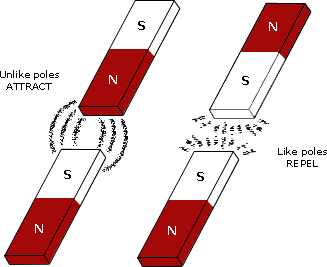
How magnets work:


Tagged , , , , , , , , , , , , ,