Category Archives: Writing

Writing Craft Q&A, Vol. VI: Sean Devereux of The Pushers (Part Two)


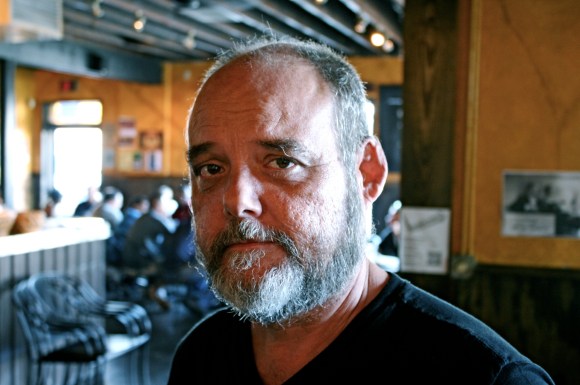
Sean Devereux of the comedy and improv group The Pushers during a rehearsal at his condo in Norfolk, Va. Photo by John Doucette.

NORFOLK, Va. – This is the second part of my talk with Sean Devereux of comedy and improv group The Pushers.

Devereux serves as the group’s co-producer, manager and co-head writer. Additionally, he and fellow founding Pusher Brad McMurran teach classes on improvisation and comedy writing at The Muse Writers Center in Norfolk, and also are involved in Improvageddon, a long form improv competition between local teams. Additionally, he recently was featured here in a Belligerent Q&A.

This discussion includes some adult language and frank discussion of jokes you may find offensive. It is toward an end. Additionally, one of the video clips contains adult language and probably is not safe for work. This Q&A had been edited for clarity and length.

It helps to have read the first part for context. You can find it here at this link.

Q: How did you get into the group?

My wife and I broke up and once that happened there was about a six month period of time where I was moping on the couch, and then I picked up Portfolio and saw auditions for a play over at The Little Theatre of Norfolk, and I said, ‘You know, I might as well.’ I did theater in high school. I was always more on the tech side but I did some acting in high school, but at least going out and auditioning beats sitting on the couch. So I went out and auditioned and got the role. … I think I had two lines …

I was really immersed. Afterwards the cast would go out drinking and meet whatever cast was rehearsing at the Generic. I just really fell into that community theater world. … I was actually kind of surprised I did fall into it. The cast I was in was kind of an all-star cast as community theater goes for the early 2000s in Hampton Roads.

Q: That, by the way, is the most specific Wikipedia page.

(Laughs.) It is. Not even Hampton Roads — early 2000s Norfolk community theater.

Q: It’s just a list with no links.

Exactly. Through that I just met a whole bunch of people. … I was having a good time with that. I started dating a girl who was involved in theater. I started a run of like four shows in a row, which is probably like a year and a half, and had just gotten burnout. The second to last play I was in was where I met Ed and Lauren Rogers, who is now in (another Hampton Roads area improv and sketch comedy  group) Plan B. We struck up a friendship. Through them I met Brad and Jeremiah (Albers) and a couple other people who would actually go on to form The Pushers.

Q: Rob Wilson (now of Plan B)?

He came in pretty close to the beginning. In fact, I wrote ‘Justice Crusaders’ with Rob in mind. For his audition, we knew he was going to be in but made him audition anyway. I’m pretty sure he read the Captain Pirate role at the audition. I’d also written another role with him in mind. …

At some length, we then discussed a sketch from an early show. Devereux wrote a sketch featuring two new characters. The following week he wrote a new sketch featuring the same characters, thinking both the original sketch and the new sketch would make it into the show. When the original sketch was cut, however, there was no context for the recurring characters. The Pushers went ahead with the new sketch, which bombed.

Q: There was no context?

It was eight or nine minutes of crickets.

Q: What did you learn from that?

Number one, we weren’t as big as we thought we were. We didn’t have a loyal crowd who would come to every single show. We learned that when you’re writing a sketch that has a recurring character, which I think is something definitely SNL has learned, you have to write the sketch almost as (if) it’s the first time people are being introduced to these characters. Which is why it’s so easy to take the game of the scene and apply it to a different setting.

Here’s ‘Justice Crusaders,’ a sketch we will discuss in some depth. This is a repeat of the link from the first post, for context. Again, NSFW:

Q: I think the writing is good. How do you build that scene?

I started that with Captain Pirate. Brad and I, we always have a couple of notebooks to jot down ideas. (He pulls one out of a bag.)

Q: Your brand is Mead.

Actually, one brand I have Mead. (Pulls another one out, reads the cover.) Downtown Norfolk Council – I’m not sure how … that was actually a work meeting. Moleskines, I actually have a couple in there. Something I can just kind of stick in my back pocket. It started with Captain Pirate. I just thought that was kind of an absurd name for a superhero. …

From there it just kind of grew. I think we came up – We don’t do it as much today, but back then we would meet and just toss out ideas. I think somebody else actually came up with Low Self Esteem Girl. Another actor was going to play Aquaman. I did notice there are some cheap jokes, like making Aquaman gay. That only happened because Jeremiah was in it. Well, Jeremiah’s playing him so obviously you’re going to have to make gay jokes. You know, never has a gay man played a character where there weren’t gay jokes.

Q: Well, stop there a minute. There are couple things there. There’s kind of a throwaway moment where Jeremiah leaves where he says something to Low Self Esteem Girl, he says “bitch” and walks out the door. How do you feel about those jokes a few years later?

Some  of them are, I would have to go back to cheap. There’s another one in there with Low Self Esteem Girl, and the reason I say we need Captain Pirate is because he’s a minority and we need a minority in the group. And Low Self Esteem Girl, Sandra (Hernandez), who is Hispanic, says well I’m a minority, and I go, ‘What do you want? A medal and a taco?’ And nowadays I don’t think I would write (that). You get a cheap joke. It doesn’t really do anything to progress the story of the sketch.

Q: Did you talk about it at the time, or was the idea just to push push push?

At the time it was just push push push. Rarely did we ever – The only sketch we ever thought maybe this is too far was a sketch I wrote called the Terri Schiavo diet where it was kind of an infomercial. There’s a new diet plan and the way it works is, you know, get into an accident so you’re in a coma and then have your husband remove the feeding tube and watch the pounds just melt away. Yeah. That was the only time we were, ‘Maybe that’s a little too far.’ But we put it up.

Q: Wait so you –

Oh yeah. We did.

Q: See, for me, that would just be too much for me. (Schiavo’s brain damage and the resulting vegetative state may have resulted from an eating disorder; she lost 65 pounds in her late teens, then struggled to keep weight off, subsisting on liquids, apparently.)

Exactly. We debated that almost until the night of the show. That sketch came from my uncle’s kind of dark sense of humor.

Q: I guess I wonder when you’re writing a sketch are you thinking this is satire? What are you satirizing?

Back then I wasn’t. I was just kind of writing whatever popped into my head. Nowadays it’s definitely more of satirizing I wouldn’t even say social conventions. Now it’s finding everyday situations that kind of bug people and just kind of take it to the absurd. Like I’m a big offender of always being on my phone. It drives Brad up the wall. So right now I’m working on a sketch where it’s two couples out on a date and three out of the four people are carrying on conversations with each other that are strictly on the phone. …

Q: Sometimes when I’m writing and trying to write toward something, if I’m commenting on a social thing or something about a (racial or ethnic) identity, it just kind of reinforces the notions some people have about those groups.

I think it is a fine line. I think back in the day, I don’t think we cared. I don’t think we ever really thought about it. We did a lot of racial humor, which we would always run it by Rob or Saeed (Wilkins), who was the other black guy. That would be our litmus test. You know, if we turned in a sketch and they didn’t punch us in the face then you know we were good to go.

Q: But that’s not much of a bar.

It’s not. Again, I think we – We had no bar. It definitely got us a reputation that we’re trying to shake now — of doing things for almost like shock value. The ‘God is dead line,’ that character, I like the idea of a priest losing his cool in the middle of a sermon. We haven’t done that sketch in two, two and half years. If we were to do it again I don’t think we would go to the ‘God is dead’ line. There’s no point to it. There might be one atheist out there who thinks it’s funny, but the rest …

Q: I mean, what do you want to do? Do you want to make people laugh or – What do you want to do with your writing?

I would say, first and foremost, laugh. I would like to say that we’ve done some satire as of late. Our Ghent hipster characters. I did one video for AltDaily where I play a politician. I do like that. Every time I write something like that I have a fear of, you know, becoming pretentious.

Q: I’m not saying it has to have a message. … One of the things I think writing of all kinds doesn’t do well is address differences, and I’m very conscious about writing in a way that reinforces differences that have been inflicted on people, not developed within that community. So I guess what I wonder is when you’re writing, not just in that context, is there something you want to accomplish with what you’re writing? Do you want to just make people laugh or do you want to keep turning back expectation? One of the things about the ‘Justice Crusaders’ is I think it does take the expectation the audience has and turns it back and it builds. There’s another sketch I was going to ask you about where you play the dad and Brad’s your son and he’s got to be gay (because his dad wants him to be). I think that sketch is about expectations turned around and it kind of builds.

It is. That sketch started out as an improv scene I did with a girl when I was taking classes in New York at Upright Citizens Brigade, and I do like looking at political correctness. I think that is a scene of like taking I wouldn’t even say political correctness, but taking it too far. Now the hip thing is to have somebody gay in your family.  You know, Queer Eye For The Straight Guy and all that. … When Queer Eye For The Straight Guy came out there was like, you know, people I knew who would watch it who would be fag this, fag that, but thought it was a great show. It was that way, and by saying they watched that it was like ‘Oh, no. I’m cool with gay people because I watch Queer Eye For The Straight Guy.’ Again, it’s taking political correctness to the – I wrote another one for Rob where a woman takes home her boyfriend to meet him for the first time and they’re shocked not because he’s black, but not black enough. They start quizzing him on Malcolm X and you know the black power movement and black authors. …

Rob a lot of times would get upset that he would always have to play the black roles. Like he couldn’t just ever play a doctor or a lawyer. It was the black lawyer or the black doctor. I was guilty of it in ‘Justice Crusaders.’ He couldn’t be just a pirate; he had to be a black pirate. And this was a sketch where he’s just supposed to be a boyfriend bracing for the fact that because he’s black a white family might be upset that their daughter is not going to be dating a white man. But they’re like no, if he’s black we want super black. …

It’s weird for a white person, you know, giving my perception of something black people have to deal with, but it almost seems that if you’re black you have to know the history of rap and hiphop because that’s your culture.

Q: In the mind of white people.

Exactly. In the mind of white people. It was kind of an exaggeration of what white people expect black people to be.

Q: Let me ask about Upright Citizens Brigade.

I think the most training I got that has helped my writing has been at Upright Citizens Brigade. They’re whole main focus — and this is applied to improv though it could be applied to all comedy — is finding the game of the scene. Stripping away everything, all the characters and things like that, what is this scene really about. That’s not that you can’t have a really funny scene that’s nothing but a bunch of crazy characters, but it seems the ones that are most successful are the ones you can break down into a simple sentence – what is this really about?

I think that’s something that has helped me the most with my writing, you know, stripping away all of the fluff. Which is hard. Nowadays when we write a scene there will be a lot of great lines and jokes and whatnot but sometimes they end up getting cut because they really have nothing to do with the game of the scene.

What does this character want? … Do they get it? Even if they don’t get it, what are they doing to get it. This other character, is he there to help him out? Is he there to be the voice of opposition? …

My process is so I’m wearing so many hats now, I have very little free time to do actual writing. I have my notebooks. I would say normally 99 percent of my sketch is written in my head. … I write almost like the nuts and bolts. I do find that because I’ve been thinking about it so long a lot of the funny bits of dialogue come out while I’m writing. I try to get out at least the nuts and bolts of the scene and go back and write in jokes later. …

Usually my premises are more relationship based ideas and usually autobiographical. One of the last scenes I wrote was right around Valentine’s Day, the day before my girlfriend apropos of nothing said, ‘You know what I really want? I want you to write me a love letter.’ I had written her a love letter, but now I’m screwed. Now when I give you the love letter on Valentine’s Day, yeah you’re going to be happy that yu got it but you’re going to think the only reason I gave you this love letter is because you told me you wanted a love letter. So I wrote a scene were a guy takes his girlfriend to a really fancy dinner and right as he’s getting ready to get down on one knee to propose she says, ‘You know the only way this could get any better is if you proposed to me.’ And then it just becomes absurd. … That actually got a pretty good response.

Q: So how did Valentine’s Day go?

It actually went well. She’s very understanding. Luckily I had other stuff to go with the love letter. …

Q: What are you plans long term?

We would love to open our own performance space, possibly a 60-seat theater. During the day we could have classes, then at night sell PBRs for $2 a bottle and put up shows. We’d like to own a theater and teach classes. And this is the pretentious part – maybe legacy. We haven’t given up the whole some day we could have our own show, but it’s not something we’re actively pursuing. We’re pretty good being a big fish in a small pond. But teaching comedy and improv, it’s kind of like making my name go on. Even if the theater is something that doesn’t make it, it’s something people will remember. …

We’re teaching. … I got pretty lucky. Hopefully we’re going to be helping people who have a similar type of dream and point them in the right direction. And it’s just fun.

Tagged , , , , , , , , , ,

Billy Collins, Joy Williams in lineup of the 34th annual ODU litfest


NORFOLK, Va. – Recently I spoke with the author, short story writer and educator John McManus about writing and somewhat less serious topics. He is co-directing the annual literary festival at Old Dominion University with Michael Pearson.

It starts this week.

I neglected to include the link at the time of our talk, and wanted to follow up with a note about the 34th annual Old Dominion University Literary Festival.

McManus recently wrote about the event in his AltDaily column, and told this to The Virginian-Pilot:

We are trying to promote writing and literature. We are trying to get the community out to readings. …

We tried to pick writers who give excellent readings. …

I always love to hear what a writer sounds like, what a writer’s voice lends to my understanding of their writing.

This year’s theme is “The Lie That Tells the Truth,” and those on the bill include Billy Collins and Joy Williams. The festival is underway today, though most of the events come fast and furious starting tomorrow.

Most events are in Norfolk, though one talk is in Virginia Beach.

A schedule follows. Please double check the litfest site. Garage parking is free for on-campus events. Events are free unless noted otherwise.

  • Playwright and director Young Jean Lee. 2 p.m., Monday, Oct. 3 @ Chandler Recital Hall, Diehn Fine and Performing Arts, 481o Elkhorn Ave., Norfolk, Va. Near W. 49th St.
  • Author Porochista Khakpour. 4 p.m., Monday, Oct. 3 @ Chandler Recital Hall.
  • The Words and Music of Paul Bowles: Christopher Sawyer-Laucanno with Andrey Kasparov & the Norfolk Chamber Consort. 7:30 p.m., Monday, Oct. 3 @ Chandler Recital Hall. Student admission $10; general admission $15.
  • Photographer Yola Monakhov. 12:30 p.m., Tuesday, Oct. 4 @ Chandler Recital Hall.
  • Poet and writer Renee Olander. 3 p.m., Tuesday, Oct. 4 @ University Village Bookstore, 4417 Monarch Way, Norfolk, Va. At W. 45th St. Garage and metered street parking nearby.
  • Poet and writer Mark Halliday. 7:30 p.m., Tuesday, Oct. 4 @ Chandler Recital Hall.
  • Author Elizabeth Searle. 12:30 p.m., Wednesday, Oct. 5 @ Virginia Beach Higher Education Center, Lecture Hall/Room 244A, 1881 University Dr., Virginia Beach, Va. Surface parking nearby. Reception and book signing to follow.
  • Poet and essayist David Swerdlow. 2 p.m., Wednesday, Oct. 5 @ Chandler Recital Hall.
  • Nonfiction writer Claire Dederer. 3:30 p.m., Wednesday, Oct. 5 @ University Village Bookstore.
  • Poet and prose writer Naomi Shihab Nye. 7:30 p.m., Wednesday, Oct. 5 @ the George M. and Linda H. Kaufman Theatre, Chrysler Museum, 245 W. Olney Rd., Norfolk. Surface lot parking & some unmetered street parking nearby.
  • Novelist Jeffrey Lent. 12:30 p.m., Thursday, Oct. 6 @ Chandler Recital Hall.
  • Novelist Scott Heim. 3 p.m., Thursday, Oct. 6 @ University Village Bookstore.
  • Poet Billy Collins: President’s Lecture Series. 7:30 p.m., Thursday, Oct. 6 @ Webb University Center. Off W. 49th St.
  • Poets Indigo Moor & Adrian Matejka. 2 p.m., Friday, Oct. 7 @ Chandler Recital Hall.
  • Journalist and author Megan Stack. 3:30 p.m., Friday, Oct. 7 @ Chandler Recital Hall.
  • Author Joy Williams. 7:30 p.m., Friday, Oct. 7 @ Chandler Recital Hall.
Tagged , , , , , , , , , ,

Writing Craft Q&A, Vol. VI: Sean Devereux of The Pushers (Part One)


Sean Devereux of The Pushers during a recent rehearsal at his Norfolk, Va., condo. Photo by John Doucette.

NORFOLK, Va. – I caught up again with Sean Devereux of comedy and improv group The Pushers at Colley Cantina for a beer and a talk about writing comedy, improvising and how far a joke can push.

Devereux serves as the group’s co-producer, manager and co-head writer. Additionally, he and fellow founding Pusher Brad McMurran teach classes on improvisation and comedy writing at The Muse Writers Center in Norfolk, and also are involved in Improvageddon, a long form improv competition between teams.

And Devereux recently was featured here in a Belligerent Q&A.

This is a long talk, broken into two parts, but those interested in comedy writing and other forms of writing — particularly finding the core structure of a work — should stick around.

This discussion includes some adult language and frank discussion of jokes you may find offensive. That mostly in the next part of the talk, which I’ll post in a couple days, but there is some adult language below.

For those who may be coming to this blog for the first time, I write it to learn from other writers and artists. I appreciate their time and honesty, and I have respect for the direct discussions they agree to be a part of. So thanks to Devereux. And thank you for reading.

Without further ado, part one of the conversation …

Q: How did you start writing?

I’ve always been a comic book nerd and my mom has comics that I wrote when I was five or six years old. I’m not a very good drawer but I could trace my hand. I would then turn (it) into a character. She has just pamphlets and pamphlets of these pages that I would draw one drawing per page and then write a caption and staple them together.

I always was very interested in comedy. … (W)hen I was in junior high and even high school, I would write scripts for The Monkees TV show. … Say what you will about their music and whether or not they played their own instruments, but their TV show still holds up as pretty funny. It’s a lot of absurd humor. It’s breaking the fourth wall type of stuff. I’ve always been fascinated with how they were kind of playing exaggerated versions of themselves, and then there were times they would break that character and go back to their real selves. I was always a big fan of that. I was a fan of Saturday Night Live.

Q: Do you remember the first time you saw SNL?

No. I do remember always liking the Coneheads. I always liked Bill Murray, but I’m not sure if that was from Ghostbusters and Caddyshack first and then Saturday Night Live after. I guess by the time I really was kind of aware of him, he must have already been off Saturday Night Live … so I must have seen repeats.

They did a big interview with (the SNL cast) in Rolling Stone and I got that issue and I must have read it a million times. It was kind of around then I decided I really would like to write for SNL, which I had forgotten about until my high school reunion a year or two ago. A lot of people were bringing it up. ‘That’s so cool – you were always talking about writing for SNL and now you’ve got your own comedy group.’

Q: What was it about the show that you liked?

I have a very short attention span so I like the sketch format better than sometimes even a half hour sitcom. Again, I always gravitated more toward comedies than dramas or even action movies. There’s just something about laughing I really enjoy.

Q: Did your folks have a good sense of humor?

My mom has a very weird sense of humor and my dad was kind of a life-of-the-party, lampshade-on-the-head type of guy.

Q: What’s a weird sense of humor for a mom?

She was a very strict mom growing up, but then there would be other times when we would be eating dinner and she’d be like, ‘Wow, these mashed potatoes smell kind of weird.’ And when we’d go in to sniff them she would push our head into them, which if my sister or I ever did it to one another we’d get in big trouble. That was our biggest joke. She always liked doing that.

She’s not like a joke teller or anything like that, but she’s really good at telling stories. She’s from New York and worked for ABC Radio in the early to mid 1960s, and her office was two doors down from Howard Cosell’s office. So she has a bunch of great stories about going out with Howard Cosell. Not dating, but just everybody from the office going out. She saw, when the Beatles came to New York, she got to go to the concert at Shea Stadium. When they gave their first press conference, she was actually in the room. She was the assistant program director at one point in time. She has a horrible taste in music. I always wonder how many really good bands never really got their shot because my mom would just toss their stuff before it ever got to the program director. She just has a way of telling a story and making it funny.

Q: You got that from her?

I think I kind of did. I’m not a joke person. When people find out I’m in The Pushers they go, ‘Oh, tell me a joke.’ I don’t know any jokes. I know maybe one knock knock joke.

Q: The one with the interrupting cow?

Well, there’s the cow one and there’s the other one where you start it. Start the joke.

Q: Knock knock.

Who’s there?

Q: (Uncomfortable silence, then laughter.)

For some reason, that’s my favorite knock knock joke. … It’s more to get back at people asking me to tell them a joke.

Q: You don’t see yourself as a joke teller, but you have to write comedy.

My comedy is very situational, or it’s more about taking something in everyday life and just exaggerating it. With the exception of the super hero sketches I do, most everything I do is more relationship based. A lot of it’s usually based on something that happened to me, and then just retelling that in sketch form and exaggerating the hell out of it.

Q: So how do you get from wanting to write for SNL to forgetting all about that dream and then (to The Pushers)?

A failed marriage.

Q: A failed marriage?

Yeah. That’ll do it. One of the reasons is I had the desire but had no idea how to act upon it. I went to George Mason University and my first semester I was actually a theater major. I did theater in high school. I had no desire to be on stage, but it was about being around the kind of people I had a kinship with. Mason at the time had a pretty competitive theater program and I couldn’t get into any of the theater courses, not even intro to theater. The only one I could take was actually taught by the Religion Department. It was themes and motifs in contemporary theater. So after my first semester I switched to English composition with an emphasis on fiction writing.

Q: What did you want to do with that?

I had no idea. At one point I thought about teaching. I still harbored thoughts of eventually writing for TV in some form.

Q: You didn’t want to write short stories or the Great American Novel?

No. I love reading those things but for some reason the actual mechanical act of writing I’m not a big fan of. Which is why I think I love sketch writing. It’s only four or five pages. … I did do a lot of short stories. I would still kind of dabble in script writing. I also ended up getting a minor in film and media studies, but it was in their Communication Department.

During my junior year, myself and some friends decided we were going to do our own TV show, kind of interview program, like a very localized The Larry Sanders Show, mocking the late night TV format. I wrote five scripts for that. We actually started filming pieces for it. The problem was, instead of going with other communication majors to help me do this, I had my friends who had no idea what they were doing and as soon as exams rolled around they abandoned the project to go study.

Q: So what was an early sketch?

Early sketches were a lot of mocking Mason campus life. They had just unveiled a new bus system that students could use, but it had weird stops. It wouldn’t stop at the Metro station, so if you needed to get to D.C., you’d stop like a half mile away and you’d walk. … Essentially they spent all this money for this new bus line that nobody ever bothered using. So we’d do live reports – it had some kind of name, like the Tide – so we’d always have a roving reporter trying to interview people on this bus. There would never be anybody on it. …

The summer between my junior and senior year, I got an internship at Channel 13. I started in the news department, because I gave a brief thought at trying to be in journalism. Two weeks in the news department, I realized that journalism really wasn’t the thing for me. You had to stick with facts. I do like exaggerating. My version of the story was always much better, or I thought was much better than what actually happened.

Q: And they frown on that.

Yeah, they do frown on embellishing. So after two weeks I moved to the production department. … So a lot of it was going out to Harborfest or Bay Days and handing out t-shirts. I went back to school and graduated and had planned to move to New York with two really good friends. My girlfriend at the time who was a year behind me had visions of the three of us going roughshod all over New York City, so if I moved up to New York she would break up with me. So I picked her over New York and moved back home to Virginia Beach.

Q: Do you know how many women they have there?

I know.

Q: Just putting that out there.

Yeah, it was not one of the smarter moves I’ve ever made.

Q: Well, I’m sure at the time it was very noble.

I don’t think so. It was sheer stupidity on my part, and then I had to go and marry her. So once I moved back here, I had no idea what I was going to do. I went to Regent for about two semesters. They actually really have a good program.

Q: Masters of communications?

Yeah. It was going to be with an emphasis in screenwriting, but I quickly found I had to start editing some of the work I turned in. Nothing against their form of Christianity, but it is very strict. I thought I could fake it for the sake of getting a degree and using their equipment and stuff like that. I only lasted probably a semester and a half before I decided to drop out. …

For me, I didn’t mind it so much at first. I come from a pretty strong Catholic family. I had an uncle who was a priest. So the fact that you had to pray before every class, I was okay with that. Not really my thing, but I was okay with that. I had a script analysis class, which was actually pretty good and then one day the professor never showed, and then the next day, the next class, she was very apologetic, but (a family member had been injured; and this incident became a distraction for the class). … We had to spend the rest of the class praying for her (relative) and by that point in time I was pretty tight on money so I started calculating how much money I was wasting by praying …

Then I was taking a television scriptwriting class, and I loved the class. The guy actually had credits to his name. … He was really cool. There was probably 40 people in the class, and the first week or two we had to pitch him ideas. We had to take an existing TV show and then pitch him ideas for possible scripts, kind of like you would do pitching –

Q: In a writers room.

Exactly. On the first day he shot down every single idea that anybody came up with. He was very harsh and mean about it. I thought, ‘Wow, that’s really weird for Regent.’ So the next class, like half the people dropped and we had to go through the same process, pitching him ideas. This time a couple people would be close to him saying, ‘Okay, that’s a good idea.’ Then something would happen and he’d say, ‘No, that sucks. Give me your next idea. No. Horrible. Move on.’ Finally, at the end of the class he said, ‘A lot of you had really great ideas, you know – things a producer might actually pick up, but when you go into a meeting  with a producer it could be right before lunchtime. He could have just been chewed out by his boss. You know, you could have the best idea in the world, but if this guy’s having a rotten day, there’s a good chance your idea is going to fall on deaf ears. … I’m going to get you ready for the real world.’

Devereux later dropped out. He had written for class, among other things, a script for Mad About You, but lost much of his Regent writing when a computer virus software apparently ate the disk.

Q: Are you sure it was the virus software?

It could have been God.

Q: He’s gotten pretty tech-savvy in the past few years.

He has. I have an uncle who was a priest who died a while back, so I’m assuming that he’s up there looking out for me. Although he had a pretty weird sense of humor, too. … I remember a Christmas, and, again all my family was in New York, and his parish was in Brooklyn. We’re all at my grandmother’s house, and my mom is one of six kids who all had pretty large families. Every Christmas was just a mass of people at my grandmother’s house. We’re all starving but we’re all sitting around the dinner table waiting because we can’t start eating until Uncle Marty came. He ended up showing three hours late. My grandmother made no bones about it that Marty was her favorite because he was a priest, so we were all kind of annoyed when he finally showed up. My mom was like, ‘Where the hell were you?’ And it’s like, ‘I’m really sorry, but a family in my parish, you know, the husband died this morning so I had to be with the family.’ And my mom was like, ‘Oh my God that’s horrible, what do you say to a family who has a loved one die on Christmas Eve?’ And without blinking his eyes, straight-laced, he’s like, ‘I hope you saved the receipts.’

So my uncle the priest had a very morbid dark sense of humor, which I’m a big fan of as well.

Q: Were you an altar boy and the whole bit?

Yeah, I was an altar boy, in Sunday School, I taught the youth group.

Q: I still have my cassock. I put it on every now and then.

Really.

Q: No.

When we first started, Jeremiah (Albers) would play all the priest roles. Back then we were always going for the cheap (jokes), so the fact that he was gay, you know, naturally he would be the one to play the priest. Now that he’s out of the group, I’m regulated to all the priest roles.

Q: Have those jokes died down?

They have. The priest character I have is an angry priest … We have a recurring series of sketches where Brad plays a kid with Tourette’s. With sketches that have recurring characters, the game of the sketch is always the same. It’s just the situation that would be different, kind of like John Belushi with the samurai character. … So Brad does this character, this kid who has Tourette’s, and either it’s at a wedding or at a funeral or just a church service where I’m giving my homily and he keeps on interrupting with more and more profane outbursts, and my character is trying to keep his cool until he finally loses it and berates the kid in front of the whole church.

Q: So what happens?

It always ends with Brad having one last outburst … so I repeat it, and my out line is always ‘God is dead.’ … and then I toss the Bible at him, and it always hits the actress behind him.

Q: Wow. A little hardcore.

Yeah.

Q: How did it play?

It’s, ah, there’s always a shock when I say it, but then when I toss the Bible it always hits the girl smack in the face and she’s a pretty good physical comedian and falls over the back of her chair, that cuts whatever – because people like watching other people fall down. … Whatever moral indignation they had at me saying God is dead is quickly forgotten by a girl getting hit in the face and falling over the back of a chair.

We discussed how Devereux came to work at a local news station after working in retail and doing freelance production assistance, which led to a full-time job. The interview picks back up with how he returned to writing.

I was writing for work. Occasionally I would come up with an idea of like, ‘Oh, this would be a good movie or a good sitcom.’ And I would jot it down, but I was really not writing other than for work for a long, long time.

Q: What would you do when you had an idea?

I would put it in a notebook. A lot of times I would start working on something. At the time I had a work ethic when it came to writing. I would write and if I would get to a sticking place instead of plowing through and keep on writing I would stop and then go back to the beginning and reread what I wrote … and I immediately would start editing myself. I can’t write directly onto a computer. I have to write longhand first. I would just start rewriting. So I have an amazing first 15 minutes of a movie because, you know, I’ve edited the hell out of them, but nothing past that. Nowadays, even if I getting to a sticking point and it’s crap I just keep on writing and then go back and start rewriting.

Q: Did you ever want to try to write a comic book?

Yes, I thought about it. I actually met an editor back in the late 1990s. … We went to the San Diego Comic-Con, and this was right before it blew up to what it is now. … There was one point in time where I had a drunken conversation with an editor from DC Comics and I don’t know how we got into it, but I actually pitched him a couple of ideas, which he was receptive to. He was actually pumping me for information. But it was almost like – not work, but it made me look at comic books with a more critical eye, which I really don’t want to do. It’s a guilty pleasure, and I kind of want to keep it a guilty pleasure.

Q: One of my short stories is about a guy who gets out of the Navy and opens up a comics shop in Norfolk.

During the period when I was kind of directionless in my writing, the one idea I kept going back to was, and I probably had close to 90 pages written, was a screenplay that is kind of a cross between High Fidelity and Clerks set in a comic book shop. A lot of it is kind of autobiographical, which is I guess is the same as the idea you had, which is the guy has a lot of great ideas for comics but he’s afraid of failing. So it’s one of those things, if you don’t try, you know. …

Today, because of the interview, I pulled up the ‘Justice Crusaders’ sketch. I don’t think I’ve seen that in a couple years. … I don’t know if it would ever make it in The Pushers these days.

Q: Why not?

It’s long. It’s like eight minutes long. Right now we’re down to if you had something five minutes long, maybe that would make it in.

Here’s ‘Justice Crusaders,’ a NSFW sketch we will discuss in some depth in the Part Two of this talk, especially some of the jokes about race and sexuality:

Q: Well, let’s talk about that sketch. I think you were here when I was talking to (McMurran and Albers) about it.

Well, let me ask you what is it about the sketch that you like?

Q: It’s got all kinds of little crises, which I like in comedy. It’s interesting and it’s absurd. Number one that all these people would answer an ad and show up. It’s got these layers of absurdity, and then I don’t want to say that it’s obvious but it’s, the setup is … Aquaman shows up, there’s a reveal that it’s Aquaman, and they don’t want him to be in the group. Which is funny.

It is. It’s Aquaman and no one wants Aquaman in the group. All he does is talk to fish. That’s not a new joke.

Q: But it’s also funny that he’s the only person who is an actual superhero.

Right. Exactly. I’ve always had a love-hate with that sketch. I think I told you this before, but when I joined a group it was strictly as a writer and then I got thrown into the performing aspect as a necessity. The entire first summer of the group I was always playing little bit parts. That scene, I wrote it, but it was the first time I essentially had the lead and was the one driving the sketch. I was scared shitless walking out on that stage. …

I think I noticed in the video today that I started out with a really kind of geeky voice and halfway through the sketch I ended up losing the voice I created for the character. Going back to what I said about comic books, where I said I never wanted to look at comic books with a critical eye, I’ve gotten to the point now where I do look at the sketch and sketch comedy. I can still enjoy it, but when I watch Saturday Night Live now, it’s never I can kick back and relax. It’s always, ‘Oh, I see what they did there. Oh yeah, that didn’t hit as much as it should have.’

Q: I always remember liking the late sketches.

Me too.

Q: They take a risk. It’s like when you go to a jazz show and the polite people stay for the first hour and leave, and the musicians open up.

I always loved the last sketch. The first sketch is always some recurring character they know is going to hit. I was really disappointed with the Betty White episode. Amy Poehler, Maya Rudolph and all the girls came back and it turned out to be – the Dana Carvey episode turned out to be the same thing. It was nothing but recurring character after recurring character. There was nothing new. You know, I have a stable of characters that I play, but I’m more about writing something new or trying to take a character out of a standard format. …

I’m trying to find out where can we put this character and make it work.

Part two is on the way …

Tagged , , , , , , , , , , , ,

Want to get published? Barely South Review’s reading period is underway


NORFOLK, Va. — Barely South Review, the online literary journal of Old Dominion University, wants submissions of new short fiction, non-fiction, poetry, and artwork.

The submission and reading period ends Nov. 30. Accepted works will be published in the April and September 2012 editions, as well as the January 2013 edition.

Barely South Review is edited by students in the MFA Creative Writing Program, part of the English Department at Old Dominion. Past contributors include Bonnie Jo Campbell, Brian Turner, Patrick Rosal, Joanne Diaz, Jill McCabe and Karen Schubert, and the review this year featured the College Poetry Prize winning work of Wendi White. Interview subjects have included Blake Bailey, Dennis Lehane and Seni Seneviratne, among others.

Full disclosure, for those who don’t know — I’m a student in the program and was on the editorial staff this past year.

Submission guidelines are located at this link. Worth checking out.

I sent Valarie Clark, managing editor of Barely South, some email questions this past week — what the pub is looking for, where it may go as it evolves, etc. The poet Luisa Igloria, director of the MFA program, also responded to the first question via email. So here’s a quick Q&A about a promising outlet for writers and artists. It has been edited for clarity.

Q: What are you looking for in submissions?

Clark:

We want the best stuff people have,  regardless of whether or not it’s considered ‘traditional’ or experimental.  If someone’s written a lovely ‘modernist’ short story, we’ll consider it. If we got some funky postmodern stuff that lacks a linear timeline or a typical narrative thread — if it’s well-written and appeals to our editors — we’ll consider it.

Igloria:

We have a wonderful opportunity to take stock of our regional and geographical positioning in the ‘south’ — with its rich history and traditions — but also recognize that such markers can mean many things to many different people. We are drawn to works that have a strong sense of their own relevance in time and place, but that are not afraid to take risks or interrogate the sense of limits, in genre and in other areas.

We are looking for works that speak to our own desire to find riveting expressions not only speaking to place and identity, but also bringing these conversations to new levels.

The following responses are from Clark.

Q: What genre would you like more submissions for, if any?

Of course, we’re happy to see all kinds, but we’d love to see more creative nonfiction. We’re talking about essays especially. If people want to send us part of their memoir, that’s great, as long as it can stand alone, apart from the greater work. The submitter can’t think to herself, ‘Well, I don’t need to explain that because it’s somewhere else in my book.’ Well, we aren’t reading your entire book. Make us want to, though, by sending us some terrific piece that can exist on it’s own.

We’re also now accepting art — photos, drawings, even small animations if they’re meaningful.  We don’t want a bunch of GIF files of folks from Jersey Shore.  That’s what message boards are for. But a GIF file of a political figure that makes a statement of some sort by using the animation —we’d consider that.

Q: Would you talk about the themes of the issues this year and how work might address them?

We’re still working on hammering out themes, but we’d do a special call for them if we decide to go that route, and editors are considering establishing themes for issues in 2013.

Q: How has Barely South done so far? Where does it go from here?

Not only are we seeing an increase in submissions already this year — including an increase in nonfiction — but one of the nonfiction essays from the inaugural issue in April 2010 was nominated for a Pushcart by a member of the Pushcart Prize panel.  Many publications nominate their own content, and we’re thrilled that someone from that prestigious contest read our humble literary journal and found quality there. And what a thrill for the author!

In the immediate future, we’re shooting for having the journal put into a downloadable PDF file that people can put on their e-readers. We hope that happens as soon as the January 2012 issue. That means we get to flex our creativity by designing an issue as if we were sending it to print — choosing layouts, fonts, all that good stuff.

We’d like to be able to do some print issues in the future, whether that’s just for ‘special issues’ like the January literary festival craft interview issue — which we’ll be doing again for 2012 — or maybe it’s a ‘limited run’ kind of thing for each issue. This is the year where BSR is starting to plan for the future and how successive ODU students are going to leave their mark on the journal.

One of the most important things for me, as managing editor, is to make sure that BSR is not only a quality publication that keeps up with changing technology trends and how the public wants to spend their time and money, but I also want the experience of putting BSR together to be an amazing one for the students. The staff is made up entirely of students in their second and third years, with some administrative assistance from first year students. This is an outstanding opportunity for the staff to learn not just how to read critically, but how to make choices about what works well together, how to make tough decisions regardless of the biography or the name associated with the piece. Soon they’re going to need to learn all the deign aspects of a print journal as we move to the PDF format.

And in the future we’d like to move to our own separate website instead of being dependent on a blog-type platform that restricts our creativity somewhat. That means we’ll have a constant need for a wide range of talents, and students who are good with technology can find a place alongside those who are more comfortable with traditional journal formats. So far this year we’ve made some terrific decisions together that are already reaping benefits — such as the choice to start accepting art as a regular type of submission.

Wow, submitting to this whole Barely South deal sounds wicked great! What do you think, Vinny?

What are you thinking of sending, Vin — a chapter from the memoir?

Yo, Vin. That’s pretty much your only move, huh?

Tagged , , , , , , , ,

Bearing Drift merger with Virginia Line Media means wider conservative platform


CHESAPEAKE, Va. – Bearing Drift, a Virginia-based provider of conservative content and opinion, announced its merger with radio content producer Virginia Line Media on Friday.

Jim Hoeft of Chesapeake, who founded Bearing Drift seven years ago, is the new president of Virginia Line Media. Norman Leahy, founder of Virginia Line, has been among Bearing Drift’s stable of contributors. Hoeft, writing under the byline J.R. Hoeft, has a background in commonwealth politics and also contributes opinion columns to The Daily Press.

Bearing Drift began as a political blog in 2004, and has expanded into social media and a subscription-only print magazine.

Virginia Line is best know for its The Score political talk radio show and online podcasts. The Score airs locally on WMBG-AM 740 in Williamsburg. It can also be heard on Richmond’s WLEE-AM 990 and Lynchburg’s WLNI-FM 105.9, as well as online.

Hoeft answered a few questions via email about what the merger might mean for both brands, as well as conservative news and public affairs content.

Q: I realize that there has been some cross-pollination between Bearing Drift and Virginia Line Media, with Norman Leahy contributing to your site and so forth. What was it that made you want to pursue the merger?

I have known Norm Leahy for years and have a great deal of respect for him and his writing and business ability. We and our partners felt that now was a good time to collaborate on a larger project that brings the best of what Virginia Line and Bearing Drift have to offer now under one platform.  Ultimately, this is a win for the Virginia conservative who is looking for a credible source of information with a variety of multimedia offerings.

Q: What are your initial goals for the merger? Will Bearing Drift readers see any immediate or eventual difference in content?

There will be no change in our content. We will continue to work to provide credible and timely commentary and information to the Virginia conservative – on demand.  However, for both Score listeners and Bearing Drift readers, they will now have the need to only visit one location.

Q: Do you see the new structure as simply a means of offering a wider platform for conservative opinion and content, or will there be other efforts to branch out?

We’re always looking for ways to enhance delivery of our content for the reader or listener. By offering a wide range of options – print, online, radio, social networks, etc. – we truly are living up to our personal goal of providing our content ‘on demand.’

Q: The company, as I understand it, is now merged into Virginia Line Media. Will the brands, so to speak, continue under their names? For example, will Bearing Drift content continue to be released under that banner or do you see a consolidation of resources, such as The Score podcasts, to one site or the other? Or any similar changes?

Virginia Line Media LLC is the name of our company. The brands we currently have for the various mediums we use will stay the same for right now; however, there’s no doubt that ‘Bearing Drift’ is the main brand and will be incorporated in some way into every product we provide.

Q: How is Bearing Drift Magazine doing?

We look forward to releasing to our subscribers our third issue of the year just before Election Day, with an article by Virginia state Sen. Mark Obenshain, an interview with Gov. Bob McDonnell and (University of Virginia Center for Politics director) Dr. Larry Sabato on the role of Virginia in 2012, analysis by Dr. Quentin Kidd on the senate election, and much more.

Q: Why did Bearing Drift want to get into the print business when your content has really built a following online?

Print, in many respects, was the original ‘on demand’ medium. You can read it anywhere at virtually anytime. We feel there is still a demand for a good, conservative print publication for our readers who prefer that medium. We also feel our advertisers get a bargain in reaching a key and influential audience virtually every time that reader picks up the magazine.

Q: Do you see an expansion of print or broadcast products?

We are continuing to grow and actively seeking opportunities for growth. Our door is always open to proposals. After all, it never hurts to talk.

Q: In Hampton Roads, we’ve seen the loss of public affairs programming, such as Joel Rubin’s show, On The Record. Do you see a time where you might produce a conservative talk television program? Online seems like a natural fit, of course, but I wonder if you see room for that on commercial TV.

It seems commercial and public TV have turned their backs to public affairs programming, but it’s mainly because the public has tuned them out. However, my feeling is that these shows have been unsuccessful because of a fake attempt at balance or an outright liberal tilt to the programming, not to mention that they have been fairly boring.

I believe a well-produced, thoughtful, and entertaining conservative program would do very well on local TV – should the left-leaning owners and producers in that field merely give it a shot. However, I don’t see that happening in the near future. Therefore, we’ll endeavor to produce our own and share it online when that time is right.

Tagged , , , , , ,

Belligerent Q&A, Vol. XII: Comedy writer and actor Sean Devereux of The Pushers


At left is Sean Devereux, producer and co-head writer of the Hampton Roads improv and sketch comedy group The Pushers. In the foreground at right is a custom Ed Carden-shaped Chia pencil holder. Photo by John Doucette.

NORFOLK, Va. – During a recent rehearsal for The Pushers’ upcoming show at The NorVa, members of the improv and sketch comedy group ran lines and worked out blocking in Sean Devereux’s Colonial Place condo.

A duo worked on a musical number on the patio. Several other cast members practiced a sketch in the living room. One ducked into the kitchen to seek out a prop magic wand for her role as (spoiler omitted) in a sketch about (spoiler omitted) in which a (subject noun) thoroughly (verbs) an (object).

I can’t reveal the details of these sketches in progress before the show, because (a) that would involve translating the strange marks on a notepad into real words and (b) The Pushers might retaliate by coming to my kids’ school and working blue. My family gets enough of that at home.

Through the rehearsal, Devereux worked on sketches, handled scripts and coordinated with colleagues. Numerous sketches were in play for the show of all new material. The group is meeting throughout the week to get ready. Several guests and some surprises are promised.

The Pushers has a rep for pushing the envelope, as the name suggests, but in a recent talk here at the blog founding member Brad McMurran discussed the work the group has done to hone its craft as an improv group and a collective of comedic actors.

Devereux, also a founding member, wears a number of hats, including as the group’s co-producer, manager and co-head writer. He happens to have written one of my favorite sketches, which I’ll discuss in another post soon, if my planned schedule of posts holds up for once. And he’s even bylined an interview with himself.

More on that in a moment.

The show is at 9 p.m., Saturday, Sept. 10, at The NorVa, 317 Monticello Ave., Norfolk. Tickets are $15 ($21 via Ticketmaster).

FYI, this Belligerent Q&A includes brief adult language.

Q: Just who do you think you are? Please use three examples in your response.

Not to sound pretentious or anything, but I see myself as true, modern-day renaissance man. Aside from being one of the stars of The Pushers, I am a multi-Emmy Award winning writer-producer. I have inadvertently amassed the largest collection of Wonder Woman memorabilia in Colonial Place … if not all of Norfolk. And I can also name all eight of the Bradford kids on Eight is Enough.

Q: In an interview last summer, you said The Pushers instituted a “no repeats” rule. Please describe the reasoning behind the no repeats rule. Is it still in effect?

I felt The Pushers had started to rely too much on old sketches instead of generating new material. In the summer of 2009, I instituted the ‘no repeat rule.’ It is still in effect with a few notable exceptions. When former Pushers return for a show, we will resurrect an old sketch or character. We also try to perform one or two ‘Best Of’ shows a year.

Q: In addition to being the producer and co-head writer for The Pushers, you teach young people how to express themselves through improvisation and sketch comedy. Why not teach them to turn that music down, cut that long hair, and get a job already?

Children respond to kindness. One of my goals in life is to become a modern day Fagin. I have found that by training kids in improv and sketch writing they are much more likely to join my roving band of pick-pocketing street urchins.

Q: You effectively are the manager of The Pushers. How much of your time is spent getting McMurran out of scrapes and/or solving mysteries?

Ah. You are obviously referring to our latest adventure, ‘Brad and Sean and The Case of Bluebeard’s Treasure.’  That one was a little scary, until we realized the real culprit was Old Man McGillicutty. Brad and I are very much like the Hardy Boys … only older, fatter and drunker.

Q: One of the things I’ve admired about some of the sketches you have written is the clear patterns of reversals – both of the expectations of characters within the scene and also of those that seem to be held by audience members who then find themselves experiencing the unfolding of not just a mere joke but a fuller story of such a specific design that it energetically unfolds from the stage into the audience and back upon itself, compounding all that has come before into all that will come, until the laughs emerge from character and dramatic action and a purer place, a special place, and it’s a place we can only get to if we work together. What does that mean, this thing I just typed up here?

It was my understanding there would be no math … during these debates.

Q: In an interview last summer, you said The Pushers instituted a “no repeats” rule. Please describe the reasoning behind the no repeats rule. Is it still in effect?

By eliminating our ability to repeat sketches, we eliminate our safety net. Now, no matter what, we are forced to write 90 minutes of pure comedy gold every show.

Q: The Pushers seem to revel in Star Wars and superhero references. If Star Wars and superheroes were to be referenced within the same sketch, would something cataclysmic happen — like when the guys in Ghostbusters cross their proton streams?

Two forces of awesomeness coming together like that could only lead to one thing … me ascending to nerd nirvana where I would be heralded as a geek god. The only reason it hasn’t happened is because I’m not quite ready to leave this mortal realm.

Q: In an interview last summer, you said The Pushers instituted a “no repeats” rule. Please describe the reasoning behind the no repeats rule. Is it still in effect?

The Pushers had fallen prey to what I like to call ‘Fat Cat Syndrome.’ By going back to the well too many times we had gotten stale and lazy. We were one repeat away from being found dead on a toilet. I feel the ‘no repeat rule’ has invigorated us comedically and sexually.

Q: Roughly a year ago, Splash Magazine contacted you about an interview, and then asked you to interview yourself. Is journalism more effective now that Splash has removed reporters from the equation?

At times I can be a very self-centered, vain egomaniac. I applaud Splash Magazine for realizing the only person truly qualified, truly worthy enough to interview me and The Pushers was … me.

(Present interview excluded of course.)

Q: I mean, did they even send any questions? Not even a few questions? Even one question asked over and over again, so it at least looked a little bit, if only initially, like they were sincere in their efforts to interview you?

See, that’s where the interview went off the rails. While Splash Magazine clearly had the vision and insight to realize I was the only one who could interview myself … they failed to realize I am a lazy schlub with a tendency to drink too much. My brief stab at journalism was not a pleasurable one.

Q: In an interview last summer, you said The Pushers instituted a “no repeats” rule. Please describe the reasoning behind the no repeats rule. Is it still in effect?

No comment.

Q: In one interview you described The Pushers as like Saturday Night Live, but funnier. Why the faint self praise?

I grew up with Saturday Night Live, I know Saturday Night Live, I’m friends with Saturday Night Live … and Saturday Night Live, you’re no Saturday Night Live.

If Lorne Michaels is reading this interview … just kidding. 🙂

Q: In an interview last summer, you said The Pushers instituted a “no repeats” rule. Please describe the reasoning behind the no repeats rule. Is it still in effect?

Since instituting the ‘no repeat rule’ we have written close to 600 sketches. We have at least five seasons worth of material and are just waiting for some eager TV executive to sign us. I have come to realize that I have a face and body for television. I mean let’s face it — nothing says ratings bonanza like me, Brad and Ed in high-def.

Q: When is repetition funny?

Only when it is done in threes.

Q: A bit more seriously, there are so many other things to do in this world besides create something. Why do you bother? What do you want to get out of this?

I honestly don’t know. There’s just something in my gut that compels me to do this.

When The Pushers formed I was just a writer. I love writing. It’s like therapy. If something bothers me at work or at home I can turn it into a funny sketch. Somewhere along the way I became, for lack of a better word, the group’s manager.

Dealing with the individual personalities of The Pushers is pure hell.  Dealing with all the nuts and bolts of putting a show together sucks.  Having to be the somewhat responsible one in a group full of dipshits blows. But for some reason, the 90 minutes we’re on stage — making people laugh — it doesn’t seem so bad.

Q: Does it have something to do with the Wonder Woman poster at your condo?

Okay — let me set the record straight. I’m a comic book nerd. I think Wonder Woman is pretty cool. Lynda Carter was the first woman I had a crush on. Years ago I bought some crazy, psychedelic 1960s Wonder Woman comics at a flea market. I happened to mention my purchase to a couple of friends … and — BAM! — suddenly I’m the Wonder Woman guy. Now when ever a friend or family members comes across something Wonder Woman, they buy it for me. I have an insane amount of Wonder Woman stuff. I like Superman better.

Q: We’ve covered so much ground. Is there anything else you would like to mention?

Come see our show at The NorVa. When The Pushers started we were a bunch of potty-mouthed morons who had no idea what we were doing. Now, six years later, we are a bunch of potty-mouthed morons who know how to put on one spectacle of a show. I think our writing has matured. We really have some clever sketches for this show. That said we also have some really dumb sketches. If you haven’t seen us in a couple of years or if you have some preconceived notion (either good or bad) of what we’re about … check us out at The NorVa. I think you’ll be surprised at what you’ll see.

In closing, here’s are two videos.

The first, a Pushers spot from last year, features Devereux. I hope to have a longer talk with him about comedy writing in the near future.

This next one’s going out to Devereux, a real sport.

Look out, Wonder Woman — dude in the bushes is packing heat — and wicked bad bronchitis:

For more information on the show at the NorVa, click this link.

If you go, there is paid garage parking at Monticello and East Freemason and on the Nordstrom side of MacArthur Center; valet parking on the Monticello side of MacArthur Center; and some metered street parking nearby. The Tide has nearby stations at Monticello or MacArthur Square, though it stops running at midnight.

And please check out the Belligerent Q&A archive.

Tagged , , , , , , , , , , , ,

Why We Have the Internet, Vol. IV: Hey Kids, It’s A Very Special Hugh Anthony Cregg III & Co. Labor Day Retrospective! Edition


PORTSMOUTH, Va. — To get in the Labor Day mood and because the blog’s Wayback Machine recently was repossessed for non payment — yo, Imaginary Board of Directors, why do I pretend to bankroll you bums? — I’ve harnessed the power of the Internet to revisit the economic past.

This past has a soundtrack by one of Patrick Bateman‘s favorite bands.

Back we go to the days after a man changed his professional name to Huey Lewis because Hugh Anthony Cregg III and the Announcements of Certain Aspects of Events Most Pressing in Importance would not fit on the merch. Can you imagine the embroidered navy golf towel ($20), blue triangle laptop skin ($29.95) or the black ceramic coffee mug ($15) with all that on it? Neither could they. Then, a laptop was where you might let your steady gal rest oh-so chastely after the sock hop. T’was a simpler time. Even actors knew their place.

We’ve got a 9.1 percent unemployment these days, according to the U.S. Bureau of Labor Statistics. But, in 1982, there were tough economic times, too. The annual unemployment rate (though it cannot be exactly compared to the current rate for some reason involving statistics, data and blah blah blah) was 9.7 percent, and crept over 10 percent, as per The New York Times.

But then something happened. A man with a harmonica sang this:

Hundred dollar car note

Two hundred rent.

I get a check on Friday,

But it’s already spent.

Sports followed in 1983. It does not address the workplace. But the labor market was improving to the tune of “I Want A New Drug”:

Why do we work? Motivation. In 1987, Cregg & Co. released “Doing It All For My Baby.” This came amid a year of strong job gains, with a jobless rate of 6.2 percent. Unemployment even dipped below 6 percent, as The Monthly Labor Review reported the following year.

And 1987 also was one of the last recorded times a video showed its attractive model as little as possible in favor of a lead singer made up like an old man:

In 1991, the national unemployment rate had risen from 5.6 percent to 6.8 percent. With another recession afoot, America was pooped. It wanted “A Couple Days Off.”

Cregg & Co. were delighted to oblige.

Which brings us closer to our time, meaning the almost present, which is only now-ish if you are not reading this later in an amazingly farfetched future in which these meandering posts get as many hits as do Belligerent Q&As.

The year was 2007. A duet version of an old song features Lewis and … Chris Gaines himself! So be it.

Meanwhile, annual unemployment was at 4.6 percent. What could possibly go wrong? Some thought the U.S. economy would crash.

Today?

Well, I am pleased to announce that Cregg & Co. are on Twitter. Have been for days. Really. So we’ve got that.

Believe me when i tell you

It gets a little rough

We work a little harder

But it never is enough

Enjoy your weekend. It’s all gonna be okay. I’ve got a bead on a used DeLorean. I’ll go back and warn somebody. Or bet on sports.

P.S. Every bass player should look like Mario Cipollina.

Tagged , , , , , , , , , , ,

Belligerent Q&A, Vol. XI: Writer and editor Tom Robotham


Writer and editor Tom Robotham did not realize he would be part of a blog post that would unsuccessfully link 1870s British light opera and 1980s American light rap when he agree to be photographed at the Taphouse yesterday in Norfolk, Va. As it turns out, parents just don't understand that I am the captain of the Pinafore. Photo by John Doucette.

NORFOLK, Va. – That gentleman, the one always over in the corner writing away at The Taphouse Grill on West 21st Street, well it’s his turn for a Belligerent Q&A.

Tom Robotham began his journalism career as an education reporter and music writer for The Staten Island Advance in New York City and has freelanced for a variety of publications, most recently as a columnist for Veer Magazine and Hampton Roads Magazine.

Most people in Hampton Roads know him as the longtime editor of PortFolio Weekly, the alternative weekly that folded a few years back. He’s also written books and taught at Old Dominion University and The Muse Writers Center in Norfolk.

Furthermore, he is never known to quail at the fury a gale, and he’s never, never sick at sea.

What never? you ask.

No never.

What never?

Hardly ever.

My point is that may come in handy this weekend.

Because, as the cutline above suggests, I bring the Gilbert & Sullivan deep cuts harder than DJ Jazzy Jeff & The Fresh Prince’s He’s the Librettist, I’m the Composer.

Regular readers (love you, Pretend Mom Who Knows How To Use A Computer) realize I often have conflicts with folks featured here, and Robotham is no exception. He’s been my editor more times than he cares to remember, and yet we’re still friends.

This Belligerent Q&A is some partial get back for all that red pen.

Q: Just who do you think you are? Please use three examples in your response.

Well, clearly, I’m a beer drinker. The Taphouse almost went out of business when I left town for two weeks this summer. Seriously, though, that pub is one of the best places I’ve ever been to – anywhere – for music and conversation, not to mention beer.

I’m also a professional arsonist. Before anyone calls the cops on me, let me explain. I figure it’s my job as a teacher (at ODU) and a writer of essays and articles, to try to set minds on fire – to get people thinking, imagining and questioning everything they’ve ever read or been told – including everything I say.

I try to convince my students in particular to question the whole mainstream American fantasy (as opposed to dream), which to my mind is based on a combination of material affluence and flatulence. I’m sure I pissed off at least one set of parents who wanted their daughter to major in something she hated; after she studied Thoreau with me, she decided to march to the beat of her own drummer and become an actress.

Third, I’m a musician – not a very good one, I must say, but my heart and soul are in it. I played a gig earlier this summer, and people didn’t throw empty PBR bottles at me, which was encouraging.

Q: You are know for thoughtful explorations of music, writing, culture, and society in your editorial and essay writing, both in your former role as editor of PortFolio Weekly and presently in work for Veer Magazine and Hampton Roads Magazine. I’d suggest that two themes I’ve seen in your writing are (1) deflation of hypocritical assertions and naysaying by certain political forces and (2) the exposure of shortcomings in our individual and (by extrapolation, perhaps) communal support for arts and culture, as well as civic involvement, namely the core aspects of public life such as government. What does that stuff I just typed mean?

I have no idea what it means. It sounds like a passage from a PhD dissertation. That said, I agree with what I think it means. I’ve written a lot about hypocrisy – including my own – as well as the marginalization of arts and culture, which to me are as important as food. And as you point out, I’ve written about civic apathy. It’s all of a piece, really. Seems to me that our country was founded on a sublime Jeffersonian dream of simplicity, beauty, education, hard work and civic engagement. Therein lies the hypocrisy. We hear a lot of blather about the ‘founding fathers.’ But for decades at least, our schools have virtually ignored arts and culture in favor of curricula that train children to be cogs in a machine. As a result, there’s little public support for the arts and a massive deficit in our capacity for critical thinking. Seems to me that most people have bought into the suburban dream of having a house on a cul de sac with a huge garage, a Ford Gargantuan, and a large backyard with an 8-foot stockade fence where they can hide from their neighbors – that is, when they’re not inside taking perverse pleasure in watching people make fools of themselves on American Idol. Meanwhile there’s a whole world of cultural beauty out there – live music and art, theater and dance – and architecture. If more people cared about beauty and artistic excellence, we wouldn’t live in these hideously ugly suburbanscapes of stripmalls and clogged boulevards. Finally, there’s the disconnect from nature. I heard recently that the average American teenager can identify 1,000 corporate logos but fewer than 10 plants. I suspect it’s not much better with adults. That’s why we have so many environmental problems.

Wow – I covered a lot of ground there and probably sound like a rambling elitist. I’ve been accused of that. So be it.

Q: You’ve written forcefully against those who oppose subsidization of public broadcasting. When did you stop loving God?

There is no doubt in my mind that God listens to NPR – especially On Point and The Jefferson Hour – and that he’s a member of the WHRO Leadership Circle.

Q: You have said that readers don’t need to be pandered to. I want to agree with you, but that sentiment neither exploits my weaknesses nor appeals to my base instincts. Discuss.

You don’t have any weaknesses that I know of. As for your base instincts, I thought we weren’t going to discuss that night of debauchery at the Thirsty Camel. I do think that our community and country would be a lot better off if we got over our anti-elitist tendencies and let experts do their thing – that includes journalists who are professional observers; they need to tell us what they think is important, and we need to listen. The great ones – from Murrow to Nat Hentoff to Bill Moyers – have always done that, and we’re better off for it.

Q: Why did they name our new light rail line after a laundry detergent instead of calling it Hampton Roads: America’s First Region’s First Light Rail System That Goes to Newtown Road In Norfolk For Now?

Because that wouldn’t have fit on the train. But it does have a nice ring to it.

Q: Do you pledge to support my campaign to reunite Screamin’ Cheetah Wheelies in Norfolk to play their 1994 modern rock hit “Ride the Tide” aboard a light rail train repeatedly for a half hour or 7.4 miles (whichever comes last)?

I do, indeed. Although I also like the idea of getting Ozzy Osbourne on board to sing ‘Crazy Train’ for 24 hours straight.

Q: Sometimes I think back to the New York days. Like the night in 1979 when Cyrus from the Gramercy Riffs called all us city gangs together at Van Cortland Park and Luther whacked Cyrus and put the whole dirty deed on us and all that heat came down from the airwaves while we headed back to our turf and I never thought we’d make it back to Coney Island in one piece especially after me and my boys ran into the Lizzies and what with what happened to Fox in the subway but at least Luther got what was coming when the Riffs learned it wasn’t us that took out Cyrus at the summit. I take it you and your crew had a better time getting back to Staten Island, yes? What was the name of your gang and what route did you take?

We came up with a name one night but promptly forgot it after smoking a lot of marijuana and eating 17 boxes of Twinkies. Come to think of it, though, there was another night I recall when some friends and I went to a party in the North Bronx, sang Beatles songs all night with two fugitive IRA members (true story), then rode a Manhattan-bound subway through the South Bronx at 3 a.m. (Not something I’d recommend.) We eventually got to the Staten Island Ferry, then caught Staten Island’s lightrail, which actually goes somewhere.

Q: Funnily enough, when we had our local scrape with those local punks in the Downtown Norfolk Crusher OGs the other day, we were only able to flee on The Tide to Newtown Road before we had to rent a car at that Avis on Virginia Beach Boulevard. Maybe light rail could be a little longer, if only to enable the Technicolor flight of nonexistant gangs. What’s the likelihood we go all the way on light rail in Hampton Roads? By “all the way” I mean to Portsmouth.

Ah, fun times.

Right now the only way it can serve local gangs is to take them all to a sit-down at that great sushi restaurant on Newtown Road. Kind of like those old meetings of the heads of the five mafia families in New York, but with California rolls.

That said, I think it’s unlikely that I will see a truly serviceable mass-transit system here in my lifetime. Right now, I figure I’m better off hopping a Norfolk Southern coal car out of West Ghent if I want to commute somewhere without a car.

Q: If the Beach continues to go slow on light rail, will HRT forces take the needed permissions, funding, and land by sword skirmish?

No. I think we’ll continue to talk about it, just as we talk about ‘regionalism’ and attracting the ‘creative class.’ Reminds me of the characters in Eugene O’Neill’s The Iceman Cometh. Just a bunch of people sitting around with their pipe dreams. Or Waiting for Godot. But I do kind of like the idea of taking Mount Trashmore, swords in hand, as we recite ‘Charge of the Lightrail Brigade,’ with apologies to Tennyson.

Q: In recent years you’ve taken up martial arts and songwriting. Where exactly are you going with this?

I’m not a very good musician, as I’ve already noted, but I kind of like my own stuff. I figure I’d better be able to defend myself at gigs because some people do tend to get pissed off when I refuse to play Jimmy Buffet songs.

Q: I understand that you’re heading back to school this fall. Will Sally Kellerman play your love interest? Who will play Lou, your chauffeur?

Lou will be played by my old friend Louie Pisigoni from Staten Island. As for my love interest, I’m holding out for Rachel McAdams. I’ve had a crush on her ever since Wedding Crashers.

As for going back to school, I’m going to give ODU a try while I continue teaching there, but I may transfer to my son’s college, room with him in a customized dorm suite complete with hot tub and hire Kurt Vonnegut to write our papers. Oh wait – he’s dead. Maybe Dave Eggers, then.

Q: We’ve covered so much ground here. Is there anything else you would like to say?

I’d like to say hi to my friends at the Taphouse. It will be at least three hours between the time they read this and the time they see me.

You can learn more about Robotham (and see a photo of him on a horse) at this link to his site.

And thanks to the magic of YouTube, former Screamin Cheetah Wheelies frontman Mike Farris will play us out:

Tagged , , , , , , , , , ,

Journalism: Q&A with Frank Batten Sr. biographer Connie Sage


NORFOLK, Va. — Connie Sage, a former writer and editor for The Virginian-Pilot, has penned a biography of the late Frank Batten Sr., founder of The Weather Channel and known in these parts as the man who led The Pilot through some of its greatest journalism triumphs.

Batten became The Pilot‘s publisher in 1954 and chairman of Landmark Communications in 1967, serving until he turned the reins over to his son, Frank Batter Jr., in 1998. Frank Batten Sr. died in 2009.

Sage will discuss and sign copies of Frank Batten: The Untold Story of the Founder of the Weather Channel on Thursday, Aug. 18, at Prince Books downtown. In addition to her time in The Pilot newsroom, the Edenton, N.C., author also worked for the staff of Landmark Communications.

The following conversation took place Monday. It has been edited for clarity and length. For those readers who don’t know, I’m a former Pilot reporter. Full disclosure.

Again, the talk and signing is at 7 p.m., Thursday, Aug. 18, at Prince Books, 109 E. Main St., Norfolk, Va. Admission is free. There is metered street parking, nearby garage parking and a surface lot behind building with limited parking.

You should go, but please don’t park in in Pete Decker’s space unless you are Pete Decker.

Q: I hoped you could talk about your career as a reporter moving up to editor, and how you joined the corporate side of things.

That’s going back a ways. I started out as a reporter in December of ’77 in the Portsmouth office and then worked for several years in Portsmouth, Norfolk and Virginia Beach. Then when The Pilot and (the now-defunct evening paper) The Ledger merged, I went out Chesapeake when we started The Clipper (a community tabloid published within The Pilot) office out there, and I was the assistant city editor working with Ron Speer, to whom the book is partially dedicated.

From there I came back into Norfolk. I was the commentary editor and then the metro editor, and then was the staff development and training director under (former Pilot editor) Cole Campbell. I kind of figured since I had one foot out of the newsroom, when they had set up their first communications director position, the first corporate communications position they had in many, many years … that I would take the elevator up one flight.

Q: Could you talk a little bit about your job there?

I was director of corporate communications. We had Landmarks Magazine, which was the first magazine the company ever had, that went throughout the whole company, and I did a news of the week and press releases and whatnot. … After that, I was still doing that, but then I shifted over to a staff development and training role where I was recruiting both journalists and sales people. I retired in 2004.

Q: When I was a reporter starting out, I had a much different view of the folks running the show than maybe I did later at The Pilot. I wonder what were the impressions of Mr. Batten when you were first starting out? If you had any interaction with him?

Not much interaction. No more than most of us had. He was always a friendly person. You’d see him in the elevator in the Norfolk office. You rarely saw him if you worked in one of the bureaus. But he was always very easy to talk with.

When I went I went up to corporate it really was eye opening because I think many of us, or at least speaking for myself, as reporters, unless you’re covering business, I didn’t think much about the business side of business, and the business side of the media business, and, in particular, ours.

Q: I take it you got to know him a little bit more up there.

Yes. He had a wonderful sense of humor, very self-effacing, incredibly humble. His door was always open. You really could just walk in. I don’t think that’s the situation these days, but, then again, I haven’t been around in several years. Of course, he had some protective secretaries, but you could always just walk right in and if he wasn’t on the phone or something he’d be more than happy to talk with you.

I think he was an unusual person in that he believed leadership was the most important quality for business, and that you had to have the ability and the instincts and the desire to lead. You had to have a desire to win and you had to do the right think by setting a standard for ethical business practices. I wrote down a list of things that he had talked about, and unfortunately a lot of that got cut from the book. I’m going mention that in my talks.

He said a leader needs to have integrity, clarity of vision, a purpose you could understand and communicate, strong values, a strong team – and that means picking the right people and creating an environment where they can succeed, developing them, and letting them make mistakes. He was really one who could not abide by backbiting. … He was really big into trust, which he got from (his uncle and local newspaper magnate) Col. (Samuel) Slover. He was a sincere person. He was authentic. He had high integrity.

Q: He really built a paper that really reflected and led the community.

Absolutely.

Q: At what point did you realize that was the culture of The Pilot? What were his thoughts on why that was?

I think all papers strive to be. I just think it’s something that, the Landmark culture – and you and I don’t know what it’s like today. When I started writing this book, one of the things we started talking about – not with Frank, but within the media community – was that Landmark never had had any layoffs. And now all that’s changed, of course, with the economy, but it was a culture that I think was inculcated in us the minute we walked in the door.

Those who didn’t fit into that culture left on their own. Well, some may have lost their jobs or gotten fired, but most of them, if they didn’t fit in, left. And that might be maybe not being as competitive as some big city newspapers, but there was a sense of collegiality. …

It was kind of in the air. I don’t know if you felt it.

Q: I did.

And I think from talking to people, particularly when I was recruiting journalists really and the salespeople, it wasn’t that way other places. … It just seemed there was a higher calling. …

If there was one fault it was it was too paternalistic. It was too family oriented. By that I mean, dead wood was kept on when it shouldn’t have been, because it was Frank’s belief that trickled down through all the managers, I believe, that you took care of your people and you made it work. And he regretted that to a certain extent. He knew that was a mistake he had made by keeping some people on longer than he should have. Of course, that was at the top ranks. But he moved people around, senior managers, senior newspaper executives, and gave them different jobs. Which was helpful for them. No one was ever pigeon-holed into a spot.  Again, because Landmark never grew hugely like the major newspapers. It was a medium-sized, privately-held company, and I think that’s another distinction. …

There weren’t a lot of places for reporters, editors or senior managers to move up to. You might go from a community newspaper to a Roanoke (The Roanoke Times, Va.) or a Greensboro (The News & Record, N.C.), or from a Greensboro or a Roanoke to The Virginian-Pilot. That was it.

Q: The Weather Channel changed things a bit as far as the size of Landmark. I haven’t read the book, but the sense is he went into that venture with a kind of faith in what it might be. That success … did that change the culture at Landmark at all? I imagine it took some of the focus away from the flagship newspaper.

I don’t think it did. … That same culture permeated throughout The Weather Channel. I for one was always excited to say I worked for the company that owns The Weather Channel. Unless you were talking to somebody in the newspaper business that knew of paper like The Pilot … not that many people knew what Landmark was.

Frank Batten’s belief in bringing on the best people continued to The Weather Channel with Decker Anstrom, who he hired to run The Weather Channel and then brought him to be CEO of Landmark – that was under Frank Jr. …

I worked for the Syracuse newspaper, I worked for a trade newspaper in New York City, I worked on the Hill as a press secretary for a year – and it’s a lot different at other places.

Q: One of the things I have wondered is what The Pilot might look like now were Mr. Batten still in charge. Do you think we would have seen all of the layoffs and the reductions? Or is that too hard to tell?

It’s difficult to say. Possibly, just because no one has seen a combination of factors like we’re seeing now. It’s not just the downturn of the economy. It’s the whole ‘how do we make money when we’ve lost so much classified advertising’ and with the advent of the Internet.

Q: What do you think the big difference between his leadership and Frank Batten Jr.’s has been?

Frank Sr. was much more hands on. Frank Jr. is a delegator. Frank Sr. was passionate about the business. I don’t think Frank Jr. is, which doesn’t mean he isn’t a good businessman. I think what I saw was that, their personalities are opposite, but Frank Sr. was very outgoing and Frank Jr. is not. He’s more of an introvert.

But what Frank Jr. brought to the table that Senior did not, as you recall, was the whole adaptation of the Internet culture. Remember when he bought the Red Hat (stock), the famous quote about he tried to get his dad to buy some stock either for himself or for Landmark, I think it was for Landmark, and he did not. Frank Sr. said, ‘He got the Red Hat, I’ve got the red face.’

Frank Jr. was much more adaptable to the changing times. Now, would Frank Sr. eventually have been? It’s hard to tell. … They are very different, and the paper’s different for a lot of reasons.

Q: Where do you see The Pilot in five years?

Personally, I think there will always be a niche for community newspapers because people are still going to want … to see their kid’s Little League picture in the community newspaper. So I would think there will always be room for those. Now for dailies? Hard to tell. It may be what you and I both read that somebody will just want business pages sent to them. And will that be electronic? Who knows? The biggest problem for everybody is how do you make money now.

Q: One of the frustrations I have is I often talk to people who say, “Well, I get all of my news online.” I say to them, “How is TMZ covering the Norfolk City Council? I mean, how is TMZ investigating whether subdivisions in Chesapeake are built near fly ash?” And they don’t really think of that. The issue that I see coming from technology is it’s not that we need a local newspaper to write movie reviews. We need a local newspaper to go to the meetings and to do the stories about our community. Do you see something like that emerging from this?

It could be. I’m just going by what I read, the annual reports from news centers and whatnot. I mean, I read Poynter Online every day. I use myself as kind of an example. I’ve been, even though I’m pretty much at my house in North Carolina in Edenton, I’ve been living on a boat off and on for the last year, and we’re going to do it for another year. Backtracking, they stopped circulating The Virginian-Pilot where I live, and so the only way I can see The Pilot is online. And since I’m not here to get a physical paper – I was getting The Wall Street Journal – everything I read now, all the news, is online. We don’t have much access to a television, so all my news is coming from online. Do I prefer a newspaper? Absolutely.

Q: I think the legacy of Frank Batten Sr. in Hampton Roads is the newspaper. Nationally and internationally, of course, it’s the Weather Channel, and to people who are interested in business. … But The Pilot is the Slover family and the Batten family’s legacy here. I wonder what becomes of that legacy if we don’t have an outlet that can cover local news?

I would disagree with you about the legacy.

His legacy – it’s in the book – will be something called the Slover Trust, which was started with his aunt’s death. This is something started with his Aunt Fay Slover’s death. … We’re looking at 50 to 60 years from now, that money will begin to be distributed by the Hampton Roads Community Foundation. Depending on what happens with the economy and the world and the stock market, it could be worth billions and it could very well be the biggest in the country. Frank Batten Sr., because he was so self-effacing, he always said that was something the Slovers did, but that’s not really true. (I)t was Franks money that grew it.

That will be the legacy. It won’t be The Pilot. Just like all the other newspapers, television stations in town, they change. The names change. The Pilot’s been around a long time through the mergers and whatnot, but that will be the real legacy. That will be huge.

Q: I think about the future of local newsgathering organizations like The Pilot because TV stations don’t compare to what The Pilot does.

No. They sure don’t.

Q: I mean, is there a way to endow that? Or to kind of protect that core news gathering capability?

Boy, I don’t know. I agree with you about television stations, particularly in our area, though I don’t see them anymore. Landmark has two TV stations, as you are aware, one in Vegas and one in Nashville, and they are kick ass stations. Incredible award winning investigations that they do. And the future of The Pilot, look at Hamilton, 9½ years. (Former commonwealth Del. Phil Hamilton recently was sentenced on and extortion and bribery conviction, as discussed oh-so poetically here.) And all that’s because of (veteran investigative reporter)  Bill Sizemore’s stories. Even though the staff is probably half of what it used to be when we were there, or whatever the proportion is, and the resources have shrunk, and the paper’s smaller, we still have at The Pilot and, I guess, throughout the rest of Landmark, that sense of duty to comfort the afflicted and afflict the comfortable. I’m really proud of what The Pilot‘s doing. It’s wonderful.

And the stories that Corinne Reilly has been doing are just phoneomenal.

Q: Oh yeah. They’re great.

Where did she come from?

Q: Don’t know her. She came after I left, but she’s terrific.

Joanne Kimberlin. There’s some fabulous writers.

Q: Absolutely. So how did this book project start?

I was getting ready to retire early to write another book I wanted to do, and Dick Barry, who was working through Landmark historical, asked me if I wanted to do this. And I thought, ‘Well sure.’

It took a lot longer than I thought it was going to. It took a long time to interview Frank because of his limitations with his laryngectomy. Sometimes we’d meet three days a week for three hours at a time, or a couple times it would be with a couple weeks in between.

Q: Was he interested in the project?

Yes. He never saw it, intentionally. Never asked to. I might have run one or two things by him for accuracy, but the upside of that is I truly believe that because he was not one to – I mean, everyone has an ego – but his was so self-effacing that I think he would have changed a lot to give other people credit when the credit was really his. On the other hand, if there are errors, they’re not caught. He never asked to see it. I really enjoyed getting to know him as well as I did. He was really just a very lovely man.

One of the interesting things to me is he was a very closed person. At least with me … he certainly was never a raconteur, never volunteered stories. A lot of the answers were yes-no. (Laughs.) … And so it was just pulling things out of him. And I would ask him about how he felt about things and for the most part – except for The Weather Channel sale, which I really think did break his heart – he would say, ‘I can’t go that deep into myself.’ He could not or would not.

Where I’m coming full circle is that when I did see him being very profusely exuberant about something was about their dog. When he almost died, I think it was in 2000 he was in a coma, the daughter in California brought out a little black Scottish terrier. Well, this dog was the apple of his eye. He just loved this dog. … It was so interesting to see that side of him.

Q: So I’m clear, this project was funded through Landmark?

No, it was not. It was funded through the Norfolk Historical Society. I think there were contributions from Landmark people, but it was not a Landmark project. I have not been paid anything.

Q: That’s a big investment of time.

It was, but I wanted to be published, and it was a foothold to learn how to write a book. Because boy was it hard. I would have been lost without (former Pilot reporter and editor) Earl Swift.

Q: How do they feel about the final product?

I don’t know. … I think they’re okay with it. What I did not have access to were Frank’s personal papers in the house. And I don’t know how many there were. He was, and I probably should have put this in the book, he was disappointed, Frank Sr., that he never kept his own papers. There were a lot of boxes in The Pilot vault, and I would dig through those. That’s where I found some of the what I thought were the aha moments, like the letter from (the late publisher of The Washington Post) Katherine Graham, but his papers don’t exist. And if there’s any personal stuff at his house, I didn’t have access to it.

Q: What do you want readers to come away with when they read this book?

I think I want them to come away with what a virtuous man this was and how unusual a man it was, a business man, in this kind of climate and culture. …

What set him apart was his legacy, and that’s being an entreprenuer, being a leader, and of course you have to look at the Civil Rights movement in the area and how he took a lead on that … how unusual that was. How he took the lead in getting a four-year college in Norfolk, and became its first rector for two terms. And then secondly I would want people to know that here was a man who could have sat back, rested on his laurels … Even though he was this successful, he never stopped trying to prove himself to his uncle. Never. …

Because of several factors. Because his uncle (Slover) was so revered, so successful. He didn’t have his own father, and her was his uncle who was his father, his grandfather he was 54 when Frank was born; he moved in with him when he was one year old — he was his montor, as Frank pointed out. He used those terms. He was always trying to live up to him, just as I suppose Frank Jr. had to try to live up to Frank Sr. and try to fill those shoes.

Q: What are you working on next?

Well there’s kind of an esoteric one I want to work on. It’s about a 14th Century mystic named Julian of Norwich.

Visit this link for more information on the event at Prince. Information on Sage’s book can also be found at the University of Virginia Press site here at this link. And here’s a link to piece by Margaret Edds in The Pilot on the book.

And if you are interested in The Pilot, which still is an important paper despite all the challenges newspapers face, you might want to read The Pilot‘s ethics policy, which includes words from Frank Batten Sr. from the 1970s, in a statement called “The Duty of Landmark Newspapers.”

Among my favorite lines:

Newspapers live entirely on the bounty of the public. The ability of journalists to report and to comment is based upon a unique grant of freedom from the public. Thus our duty is clear: It is to serve the public with skill and character, and to exercise First Amendment freedoms with vigor and responsibility.

Our news reports should never be influenced by the private interests of the owners or of any other group. Our editorials should exhibit vigor and courage, always respectful of contrary opinion, never tailored to the whims of the editor or publisher.

And:

A great newspaper is distinguished by the balance, fairness and authority of its reporting and editing. Such a newspaper searches as hard for strengths and accomplishment as for weakness and failure. Rather than demoralize its community, the great newspaper will, by honest and intelligent journalism, inspire people to do better.

Tagged , , , , , , , , ,

A delegate and a poem, such as they are


NORFOLK, Va. — A federal judge in Richmond today sentenced former state Del. Phil Hamilton, who recently was convicted of bribery and extortion, to serve 9½ years in prison.

That sentence – meaning my lede, not Hamilton’s – is pretty much a total ripoff of Julian Walker’s opening line in The Virginian-Pilots online report. Homage, baby.

The other sentence – Hamilton’s, not my lede – is my cheap cue as a native Ocean Stater to inform Hamilton that he has a marvelous future at virtually any level of Rhode Island government. After all, my home state’s cookie jar has had more hands caught in it than, oh, let’s just let that thought end.

Walker reports:

The decision concludes this phase of a saga that dates to 2006, when prosecutors said Hamilton began soliciting a paid position through Old Dominion University with a teacher training program for which he helped secured $500,000 in state start-up funds the following year.

Hamilton, 59, was subsequently given a job with a $40,000 annual salary at ODU’s Center for Teacher Quality and Educational Leadership, a title he held for about two years until after the arrangement was exposed by The Virginian-Pilot.

He wasn’t taken into custody after the hearing, but must surrender to federal authorities by Sept. 19 to begin his sentence. His attorney said Hamilton will appeal the verdict.

So. The saga has another phase. Still, the Imaginary Board of Trustees has granted me permission to borrow the key to the Wayback Machine. Quite a fuss went up among the imaginary trustees when I invoked the timeliness clause. So the Wayback Machine is fired up, and we can revisit my terrible “poem” about Hamilton’s slippery dealing with a very fine public university where I just happen to attend grad school. Let’s travel together, way back to … May 2011.

Ahem:

‘Quid Pro Oh No (Revised)’

A delegate tried to secure secured funding

for a state university

with a string attached

and unlike the assembly

that bestows such funds

it wasn’t general at all – no! –

the string was specific,

tied to the assemblyman himself,

job hunting, job getting

in a ‘corrupt arrangement,’

federal prosecutors allege

prosecutors argued in court

with conviction enough

for enough of a conviction,

and so a federal court judge

named Henry E. Hudson,

whose initials are HEH,

was resigned to give the gift

that otherwise grows more elusive

as mortal men give it chase,

‘the toughest decision I’ve made

in my 13 years as a judge,’

this gift, the hardest time itself.

I promise I will have no reason to repost this “poem” for another 9½ years. That is a mere 8.6868 years for my friends who use the metric system. Respect to the math.

Exceptions:

  1. I’ll return to this bit earlier, perhaps, with good behavior.
  2. And what if the promised appeal goes forward, and perchance succeeds? We are nothing if not the sum of our revisions.

Back by popular demand, here is a pointless link to the post you just read.

Tagged , , , ,