
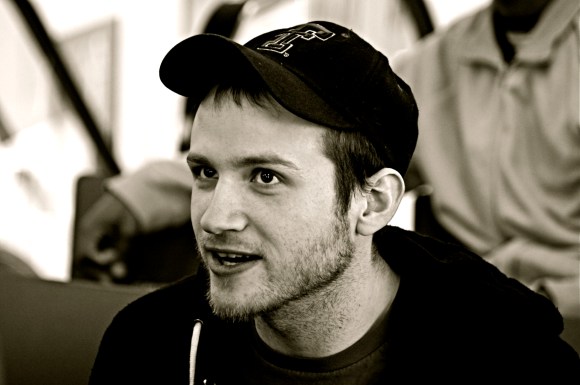
Travis A. Everett, who is from Texas, wears a hat with not one but two Ts on it in this photo. He is the founder of Tunnel Traffic, an occasional reading series. Texans seem to like a certain kind of alliteration. Photo by John-Henry Doucette.
Tunnel Traffic is an open-mike reading series that generally is held at Borjo Coffeehouse near Old Dominion University in Norfolk, Va.
The series was developed by Travis A. Everett in coordination with the MFA Creative Writing Program at Old Dominion University. One of its sponsors is Barely South Review, the program’s online literary magazine. By way of full disclosure, I’m a student in the MFA program and was one of the fiction readers for the review this past year.
I recently traded emails with Everett, since the next reading is coming up on Wednesday, April 13. The topical reading series is meant inspire new work and provide reading experience for students, according to the webpage. Writers write to prompts announced before each reading. The vibe is meant to be low-pressure and casual.
In addition to his studies at ODU, Everett is a poet and the founding editor of escarp, a text message-based review of “super brief literature.”
This Belligerent Q&A is about Tunnel Traffic. In case you missed the photo cutline above, let me mention that Everett is from Texas. I wonder if that will come up.
Q: Just who do you think you are? Please use three examples in your response.
- An accident waiting to happen
- A typography/design geek
- A weekend programmer
Q: It seems to be an interesting choice to name something Tunnel Traffic and expect people from Hampton Roads to want to experience it. Please describe your marketing plan in a limerick, haiku, or rhyming couplets.
I come from West Texas
where sky is the coolest thing
you can drive under
Q: The bling, the flashy cars, the reality shows – hasn’t the public had enough of the ostentatious lifestyles of the creative writing community and its twisted, insatiable passion for the subversive forms of fiction, poetry and narrative nonfiction?
Well, I think that’s actually one of the problems contemporary literature faces. So the equivalent of a Benz and a bottle of Cristal is a stuffy reading voice or a highly referential style that both resist non-writers — and the reality-show analog is writing about a writerly life like it’ll matter to anyone who isn’t a writer. There’s room for that, of course, but I also think it’s a really self-fulfilling prophecy to bemoan the lack of readership for very writerly books of poetry and prose. So in that sense, yeah — I think the public has had its fill of a specific kind of writerly lifestyle.
Q: Your readings are “topical” – please explain. Does that mean topical like a Jay Leno monologue, or topical in a way that prolongs one’s will to live?
Or topical like anti-itch cream? So you can listen to one late night monologue and hear a joke about, let’s say, a runaway Toyota, and you might laugh. But a single joke doesn’t show how far the content can stretch. Let’s say it’s topical like a roast, or a slam-dunk contest: shedding the usual rules of the dance give it a relaxed, fun, informal atmosphere with an undercurrent of both inter- and intra-personal competition.
In some sense it doesn’t matter, on The Tonight Show, if Jay has the best Toyota joke or not (as long as his joke is at least funny) because he’s not in a topical context. But if you take a number of late-night hosts and other comedians and let them know you’re having a runaway-Toyota-joke-night, they’re each going to be looking for an angle no one else will take and as a result they’ll cover a lot more territory, territory they probably wouldn’t have opened up as individuals outside of that context.
Q. We’ve covered so much ground here. What else would you like to say?
If you commit to coming, a topical prompt will help you write something you probably wouldn’t have written otherwise. Seeing how other writers approach the same task can help expand your sense of what words can do. It’s a low-pressure way to get reading experience.
The next Tunnel Traffic reading is scheduled from 8 to 9:30 p.m., Wednesday, April 13, at Borjo at W. 45th St. and Monarch Way. The topics are Easter eggs and/or gunpowder. Members of the public are welcome to come out either to listen or to read.


 John-Henry Doucette